

Protection of Nature and Biodiversity Roadmap
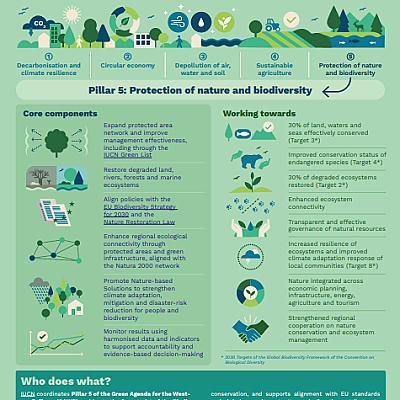
Under the Green Agenda for the Western Balkans, the Protection of Nature and Biodiversity Pillar supports the conservation and restoration of ecosystems, habitats and species across the region, in alignment with the EU nature acquis. It contributes to safeguarding ecosystem services, strengthening biodiversity governance and integrating Nature-based Solutions into sectoral policies.
In the Green Agenda Action Plan (2021–2030), this pillar focuses on aligning domestic-level legislation with the EU nature acquis, strengthening biodiversity monitoring systems, promoting forest landscape restoration, improving regional ecological connectivity, and preparing for the Natura 2000 network.
The Revised Action Plan (2025–2030) maintains these priorities while placing stronger emphasis on implementation and measurable delivery. Particular focus is given to the development of a coordinated WB6 Biodiversity Strategic Plan, the update of domestic-level biodiversity strategies, the preparation and implementation of nature restoration plans, and the strengthening of biodiversity monitoring and ecosystem restoration efforts across the region.
KEY RECOMMENDATIONS
- Build on the Dubrovnik Declaration and the endorsed Outline of the WB6 Biodiversity Strategic Plan 2030 by advancing the development and adoption of the Plan at the 2026 GAWB Ministerial Meeting, and use this regional commitment as the basis for the Western Balkans Six (WB6) to establish domestic implementation frameworks with designated institutional leads, dedicated budget lines and indicative timelines. The Plan’s five strategic goals, namely expanding and effectively managing protected areas, restoring degraded ecosystems, preventing species loss, integrating biodiversity into key sectors, and improving governance, knowledge and financing, should be reflected in updated domestic-level biodiversity strategies and integrated into Economic Reform Programmes and IPA III programming documents.
- Commission and publish the State of Nature in the Western Balkans – Biodiversity Conservation Report (WBBCR) on schedule, ensuring that its findings inform the next cycle of domestic-level biodiversity action plans and feed into the EU accession screening process under Chapter 27. The report should establish a baseline against which progress on halting biodiversity loss can be tracked and reported to the European Commission.
- Establish a regional biodiversity monitoring and evaluation framework with harmonised indicators, including quantitative targets for the number, extent and management effectiveness of protected areas, the status of key threatened species such as the Balkan lynx, the Dalmatian pelican and endemic freshwater fish, and the condition of priority habitats including rivers, karst wetlands and old-growth forests. Monitoring data should be reported annually through the GAWB Observatory Platform.
- Close the gap between legislation and implementation on protected area management and environmental impact assessment. Albania should repeal the 2024 amendments to its Protected Areas Law that create exemptions for infrastructure and tourism projects; Bosnia and Herzegovina should establish a Natura 2000 network and a biodiversity monitoring system; Kosovo* should substantially increase administrative capacity for protected area management; and all WB6 should apply Environmental Impact Assessment and Strategic Environmental Assessment rigorously to all projects, including those with intraregional impacts on Ramsar sites and Important Bird Areas.
- Advance the development of the WB6 Forest Landscape Restoration Plan, drawing on the Restoration Opportunities Assessment Report (ROAR) expected to be finalised in 2026. The Plan should be operationalised through domestic restoration plans, with priority given to interjurisdictional landscapes, disaster-prone areas and habitats critical for biodiversity connectivity, and with resource mobilisation from the donor community and the private sector explored in parallel with plan preparation.
- Integrate Nature-based Solutions systematically into climate adaptation planning, infrastructure approvals and spatial planning frameworks across all WB6, in line with the Green Agenda for the Western Balkans Action Plan 2025–2030, the EU Nature Restoration Law and the WB6 Climate Adaptation Roadmap, designating Nature-based Solutions as a cross-cutting requirement in domestic-level climate adaptation strategies, urban planning ordinances and flood risk management plans.
- Strengthen cross-sectoral governance by embedding biodiversity considerations into transport, energy, agriculture and tourism planning, drawing on the technical guidance available through existing regional frameworks, including the Biodiversity Task Force for the Western Balkans (BDTF WB) and the relevant Technical Expert Groups (TEGs), to support biodiversity mainstreaming across sectors at the domestic level.
REGIONAL STATUS OVERVIEW
The information presented below is based on the Reports on the Implementation of the Green Agenda for the Western Balkans Action Plan (GARI). These reports consolidate validated inputs from regional bodies and authorities, as well as biodiversity monitoring systems, across the WB6. They assess developments in biodiversity governance, protected area planning, ecosystem restoration and alignment with EU and global biodiversity frameworks.
The Biodiversity Task Force of the Western Balkans (BDTF WB), under the guidance of International Union for Conservation of Nature (IUCN) as its Secretariat, facilitates regional coordination and supports alignment with the EU nature acquis, the EU Biodiversity Strategy for 2030, and the Kunming–Montreal Global Biodiversity Framework (KMBF).
The 2025 GARI reports that regional biodiversity governance advanced significantly during the reporting period, with the Outline of the WB6 Biodiversity Strategic Plan 2030 endorsed by ministers of environment through the Dubrovnik Declaration on 14 October 2025 and published in the same month. Progress across the WB6 nonetheless remains uneven. Most domestic-level biodiversity strategies and action plans have expired or require updating to align with the Kunming–Montreal Global Biodiversity Framework and the EU Biodiversity Strategy for 2030, no new Emerald Network sites have been proposed since 2011, and the assessment identifies the gap between legal frameworks and on-the-ground implementation as the principal constraint on delivery.