

Action 52
Prepare nature protection and restoration plans including for marine areas

ROADMAP PROGRESS
The 2025 GARI reports that the region has committed to developing coordinated protection and restoration frameworks spanning terrestrial, freshwater and marine ecosystems, guided by the Green Agenda for the Western Balkans and aligned with the EU Nature Restoration Law and the Kunming–Montreal Global Biodiversity Framework. Progress during the reporting period was concentrated at the regional and programmatic level. The Biodiversity Task Force for the Western Balkans, coordinated by IUCN under the Greening the Western Balkans and ADAPT 2.0 projects, laid the technical and governance foundations for domestic-level and regional restoration plans across terrestrial, freshwater and, to a more limited degree, marine ecosystems.
On the terrestrial and freshwater side, the most concrete development of the reporting period was the initiation of the WB6 Forest Landscape Restoration Plan, the preparation of which is advancing under ADAPT 2.0 (IUCN and Sida). The Restoration Opportunities Assessment Report, which will identify priority landscapes for restoration across the region, is expected to be finalised in 2026, after which the Plan itself will be prepared. The Thematic Group on Ecosystem Restoration, constituted in 2025 and meeting for the first time in January 2026, will provide scientific and strategic guidance for the Plan and other restoration-oriented deliverables. Nature-based Solutions pilot sites in Serbia (Gledić Mountains), Albania (Shushica/Elbasan) and North Macedonia (Bukovikj) continue to generate baseline data and lessons relevant to the development of domestic-level restoration plans.
The marine dimension of nature protection planning remains significantly underdeveloped relative to terrestrial and freshwater priorities. None of the WB6 with an Adriatic coastline has adopted a comprehensive marine spatial plan aligned with the EU Marine Strategy Framework Directive, and marine protected area coverage remains critically low: Montenegro’s marine waters are under formal protection at below 2%, against a 2030 target of 30%. The endorsement through the Dubrovnik Declaration of the Regional Action Plan on Plastic Pollution Prevention, including Marine Litter is the first explicit regional commitment addressing Adriatic marine ecosystem pressures, although it does not constitute a nature protection or marine spatial planning instrument. Key coastal wetland sites, including the Ulcinj Salina (Montenegro, Ramsar Site no. 2399 and Nature Park since 2019), the Narta Lagoon (Albania) and Boka Kotorska Bay (Montenegro), remain without active, resourced management plans. At the Ulcinj Salina, outstanding requirements include an operational management regime and the resumption of salt production, which sustains the halophyte habitats on which 252 recorded bird species depend; the EU has made effective protection of the Salina a benchmark condition for Montenegro’s accession. The forthcoming WBBCR is expected to provide the first comprehensive, evidence-based assessment of protection and restoration needs across all ecosystem types, including coastal and marine systems.
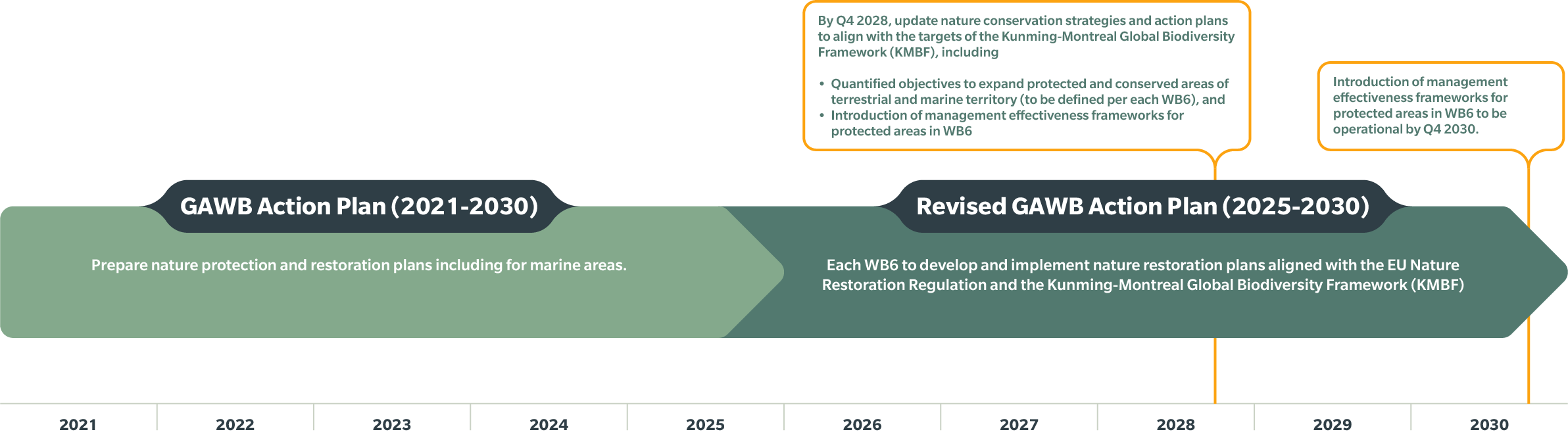
Note: Action 52 of the firstGreen Agenda Action Plan (2021–2030) is retained under the Revised Action Plan (2025–2030) through Actions 37 and 38. The revised framework strengthens alignment with international biodiversity commitments by requiring the update of nature conservation strategies in line with the Kunming–Montreal Global Biodiversity Framework (KMBF) and the preparation and implementation of dedicated nature restoration plans, including for marine areas, consistent with the EU Nature Restoration Regulation.
Source: European Environment Agency, Designated terrestrial protected areas in Europe (published October 2025, data to end-2023). Data compiled in Regional Cooperation Council (RCC) (2025) Appendix 1: Indicators, Report on the Implementation of the Green Agenda for the Western Balkans Action Plan (GARI 2025).
Note: Terrestrial protected area coverage as a share of land area, counting Emerald Network sites together with other domestic designations. Data refer to end-2023.