

Action 58
Development of green infrastructures and ecosystem connectivity
ROADMAP PROGRESS
The 2025 GARI assesses progress on green infrastructure and ecological connectivity primarily through the Emerald Network, the region’s operative framework for protected areas and ecological connectivity under the Bern Convention and the pre-accession equivalent of the EU Natura 2000 network. The key event of the reporting period was the fifteenth meeting of the Bern Convention’s Group of Experts on Protected Areas and Ecological Networks, held on 7 and 8 October 2025 in Bar, Montenegro, the first time the meeting was hosted in the WB6. The meeting reviewed the status of the Emerald Network across Contracting Parties with the explicit aim of supporting them in designating new protected sites and improving the management of existing ones, provisionally adopted a new Emerald Network Standard Data Form designed to strengthen the consistency of data collection, and discussed criteria for assessing negative changes to Emerald sites. Participants also visited Lake Skadar, one of Montenegro’s principal Emerald sites.
The meeting took place against a backdrop of persistently inadequate implementation across the WB6. No new Emerald sites have been proposed by any of the WB6 since the network was first established in 2011, a gap of more than fourteen years, and current sufficiency rates fall far short of the Bern Convention’s 2030 target of 35%: Bosnia and Herzegovina stands at 0.7%, Serbia at 13.5%, North Macedonia at 16%, Montenegro at 16.3% and Albania at 28.3%. At the forty-fourth Standing Committee meeting in December 2024, representatives of Bosnia and Herzegovina, Montenegro and Serbia acknowledged that sufficient scientific and technical information exists to propose new sites but cited political and administrative obstacles as the reasons for inaction, while expressing readiness to advance in the coming period. Only one biogeographical seminar has been convened to assess Emerald sites in the Western Balkans Six, in 2011, leaving the network’s sufficiency formally unevaluated for over a decade.
Domestic-level governance gaps compound the regional picture. In Montenegro, despite significant progress in mapping territory for the Natura 2000 ecological network, gaps remain between mapped biodiversity values and their reflection in spatial planning frameworks. In North Macedonia, the domestic-level biodiversity information system remains non-functional, impeding the identification and formal designation of potential Natura 2000 and Emerald sites. In Albania, recent legislative changes to the protected areas framework have raised concerns regarding the alignment of domestic legislation with EU nature protection standards, a process supported through the EU Environment Partnership Programme for Accession (EPPA). The gap between mapped biodiversity values and legally protected areas is particularly acute for river ecosystems: assessments conducted under the Emerald Network process have identified the Vjosa, Black Drin, Neretva, Bosna, Morača and Vardar, among others, as priorities for inclusion as Areas of Special Conservation Interest, and these rivers and their tributaries represent both critical ecological corridors and some of the last free-flowing river systems in Europe. The systematic assessment of ecological network status and connectivity needs across the WB6 is a designated task of the forthcoming WBBCR, which will provide the first comprehensive, science-based baseline against which progress under this action can be measured and will generate the evidence needed to inform coordinated proposals for new Emerald sites and cross-border/boundary ecological corridor designations.
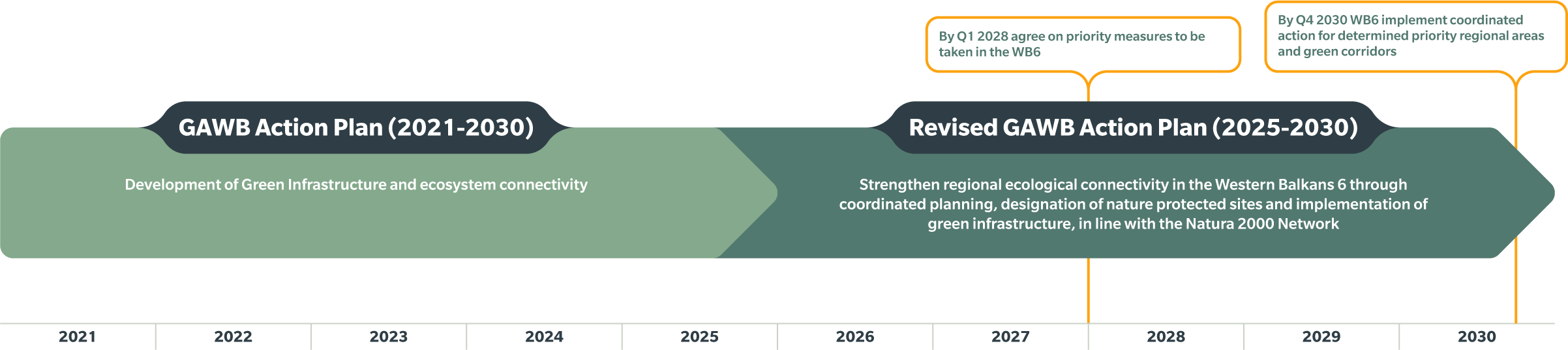
Note: Action 58 of the first Green Action Plan (2021–2030) is transferred to the Revised Action Plan (2025–2030) as Action 41, which focuses on strengthening regional ecological connectivity through coordinated planning, designation of protected areas and the development of green infrastructure in line with the Natura 2000 network.