

Action 57a
Biodiversity Monitoring and Evaluation Framework
ROADMAP PROGRESS
The 2025 GARI reports that the development of a Biodiversity Monitoring and Evaluation Framework (BMEF) for the WB6 is a dedicated deliverable under the Greening the Western Balkans project (IUCN, August 2024 to July 2028) and is embedded as a core component of the BSP 2030, the Outline of which was endorsed in October 2025. The Framework is designed to provide the evidence base for policy decisions across the biodiversity pillar and to enable standardised progress reporting to the EU and to the Convention on Biological Diversity. Its development responds to two converging needs. At regional level, the BSP 2030 requires a common system of harmonised biodiversity indicators to assess implementation consistently across all WB6. At global level, the resumed session of CBD COP16 in Rome in February 2025 adopted a finalised set of indicators for tracking progress towards all 23 targets of the Kunming–Montreal Global Biodiversity Framework, which parties are required to use in their seventh domestic-level reports due in 2026; the BMEF is intended to be designed in alignment with that monitoring framework so that WB6 reporting satisfies regional and global obligations within a single coherent system.
The Framework will draw on and integrate outputs from several concurrent workstreams. The WBBCR, whose terms of reference were issued in August 2025, will provide the baseline data on species status, habitat condition, protected area effectiveness and ecosystem integrity against which future monitoring results are benchmarked. The Thematic Group on Biodiversity Conservation, established under the BDTF WB in June and July 2025 and inaugurated in January 2026, is tasked with providing technical guidance on indicator selection, monitoring methodologies and evaluation criteria. The Thematic Group on Ecosystem Restoration provides parallel guidance on restoration-specific indicators, including forest landscape integrity, habitat connectivity and species recovery metrics. The 2025 SWG RRD report on sustainable forest management documented the current fragmentation of biodiversity monitoring across the WB6, noting that approaches are often intermittent, inconsistent and time-limited to inventory periods, and that Kosovo* has no standardised form for collecting and monitoring biodiversity data.
The BMEF is expected to establish a set of regionally harmonised core biodiversity indicators covering species, habitats, protected area coverage and management effectiveness, ecosystem services and pressures; agreed methodologies and data collection standards for each indicator; reporting templates compatible with both the reporting requirements of the Convention on Biological Diversity and the GAWB Observatory Platform being developed by the RCC; and a governance arrangement specifying the roles of domestic-level environmental agencies, the BDTF WB, the Biodiversity Information Hub and IUCN as technical coordinator. The Framework remained in a preparatory and design phase during the 2024 to 2025 reporting period, with full development and operationalisation expected progressively over 2026 and 2027.
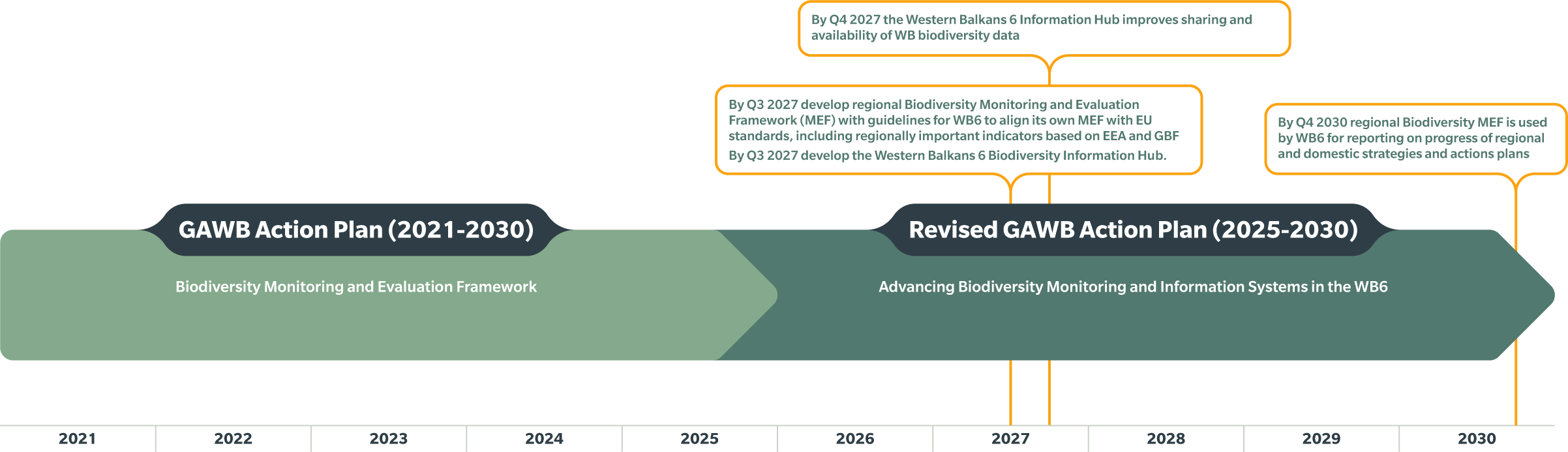
Note: Action 57a of the first Green Action Plan (2021–2030), relating to the development of a Biodiversity Monitoring and Evaluation Framework, is integrated into Action 40 of the Revised Action Plan (2025–2030) together with Action 57.