

Action 51a
Develop a Western Balkans Biodiversity Report
ROADMAP PROGRESS
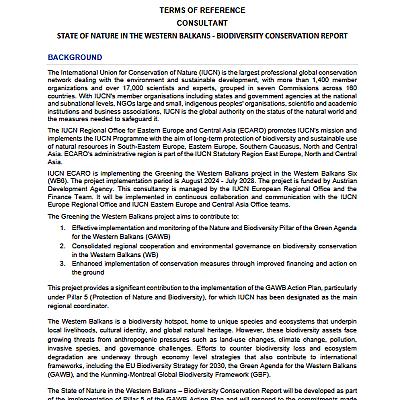
The 2025 GARI reports that work is under way on the State of Nature in the Western Balkans – Biodiversity Conservation Report (WBBCR), which will provide a comprehensive assessment of the current status and trends of species, habitats and ecosystems across the region. The Terms of Reference were published by IUCN in August 2025, and the report is being coordinated by IUCN under the BDTF WB and developed in consultation with public authorities, nature conservation institutes and civil society. The 2025 GARI recommends that the report establish a baseline against which progress on halting biodiversity loss can be tracked and reported to the European Commission.
A regional biodiversity assessment prepared by EuroNatur was launched on 21 November 2024 at the European Parliament in Brussels. It examined the state of biodiversity across the WB6 through case studies in key ecosystems, including the Vjosë-Narta wetlands in Albania, Livanjsko Polje in Bosnia and Herzegovina, the Ulcinj Salina in Montenegro and the transboundary habitat of the critically endangered Balkan lynx, of which fewer than 40 remain in the wild. Its central finding was that, although domestic legislation and international conventions nominally protect areas and species of conservation interest, the gap between legal frameworks and on-the-ground implementation is acute and widening, with specific breaches of the EU Birds and Habitats Directives and of the Bern Convention documented.
The 2025 GARI sets out the resulting priorities for the WB6. Bosnia and Herzegovina needs to establish a Natura 2000 network and a biodiversity monitoring system. The administrative capacity of Kosovo* for environmental governance was assessed as critically low. Albania’s 2024 amendments to its Protected Areas Law were identified as a regressive step, creating carve-outs for infrastructure, irrigation and tourism development within designated areas, and functional, well-resourced management plans are required for the Vjosa River Park and other sites. Montenegro is encouraged to align coastal management with biodiversity standards and to protect marine biodiversity from tourism expansion and unsustainable aquaculture. North Macedonia needs to restore degraded ecosystems, with concrete rehabilitation plans for aquatic biodiversity, particularly in the Ohrid–Prespa basin, to finalise and implement domestic biodiversity legislation aligned with EU Natura 2000 standards, and to mitigate infrastructure impacts by enforcing strict environmental impact assessment for mining and industrial infrastructure to protect threatened habitats, with a focus on implementing the Forest Landscape Restoration Plan. The assessment records the European Commission’s conclusion that accession progress for all WB6 is contingent on demonstrable results on nature protection.
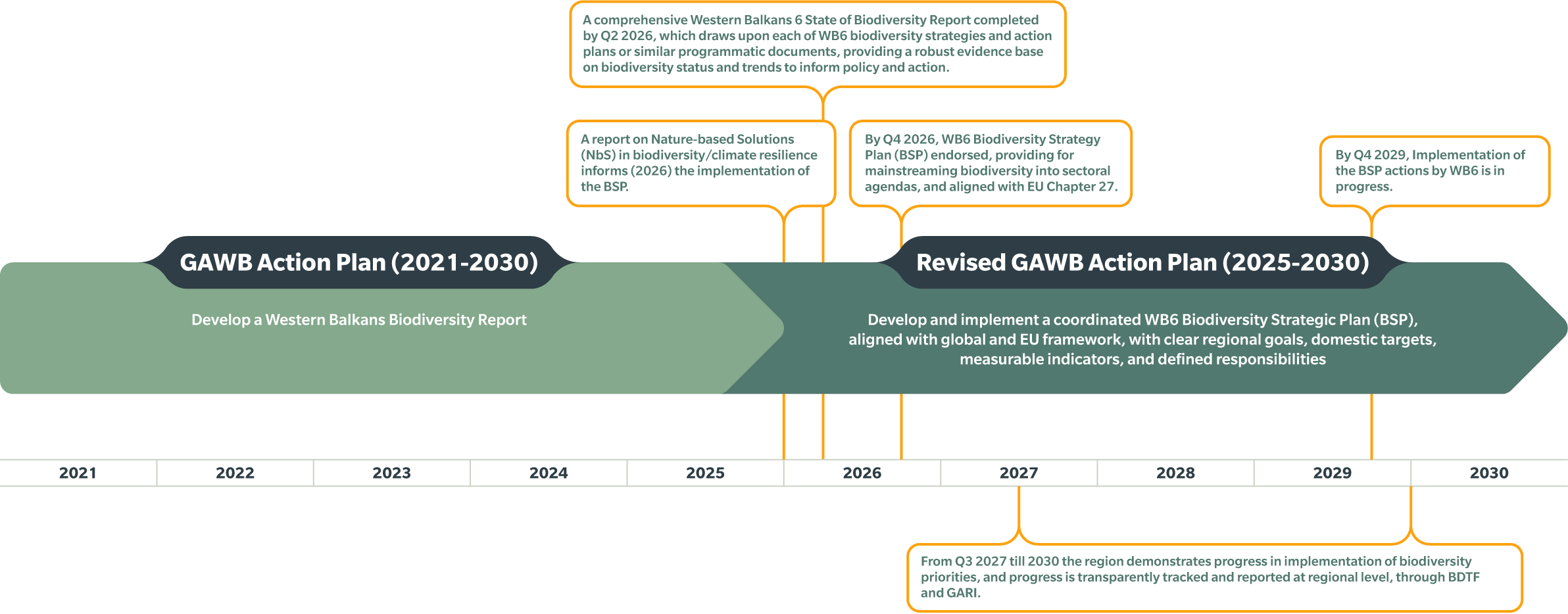
Note: Action 51 of the firstGreen Agenda Action Plan (2021–2030), relating to the establishment of monitoring and reporting mechanisms for the regional Biodiversity Strategic Plan, is consolidated in the Revised Action Plan (2025–2030) under Action 36, which establishes the development and implementation of a coordinated WB6 Biodiversity Strategic Plan aligned with EU and global biodiversity frameworks.