

Action 29
Improve sustainability of primary production of raw materials
ROADMAP PROGRESS
The 2025 GARI records a significant intensification of the discourse surrounding primary raw material production in the WB6, driven by the full operationalisation of the EU’s Critical Raw Materials Act (CRMA) and the geopolitical imperative for resource security. The region is firmly positioned as an important partner for the EU in diversifying supply chains and reducing dependencies on other global actors, while the WB6 have increasingly recognised the strategic and economic importance of critical raw materials, identifying the sector as an opportunity for industrial development, investment, employment generation and integration into European raw materials value chains. In several of the WB6, critical raw materials have been prioritised within smart specialisation strategies and broader economic development agendas. This approach was formalised through the EU-Serbia strategic partnership on sustainable raw materials, battery value chains and electric vehicles, signed in July 2024 and actively pursued throughout 2025, while individual projects, including the Jadar lithium project, remain subject to domestic legislation, permitting procedures and environmental impact assessment requirements. In June 2025, the European Commission designated the Jadar project a Strategic Project under the CRMA with the aim of accelerating its development. At the same time, civil society organisations, experts and local communities continued to provide data, analysis and awareness-raising, with particular emphasis on the right to a healthy environment. The adoption of the RESourceEU Action Plan in December 2025 further accelerated implementation of the EU critical raw materials strategy, explicitly building on the CRMA framework.
Progress on sustainable primary raw materials governance across the WB6 remained uneven in 2025. Areas requiring further development include the quality of environmental impact assessment (EIA) and strategic environmental assessment (SEA), mining waste and tailings management, site rehabilitation obligations, raw material traceability, recovery of secondary raw materials from extractive waste, environmental, social and governance (ESG) compliance and the uptake of cleaner technologies in mining and processing. The European Commission’s 2025 Enlargement Package noted that the EIA and SEA implementation requires strengthening across the WB6. Incidents such as the tailings spill at the Toranica mine in North Macedonia and water quality concerns reported in the vicinity of the Vareš mine in Bosnia and Herzegovina have underlined the importance of effective monitoring systems and consistent enforcement of existing regulatory frameworks. Bridging the gap between formal legislative requirements and their practical application on the ground remains the central challenge for the sector across the region.
Domestic developments in 2025 were mixed. Serbia adopted the Strategy for the Management of Mineral and Other Geological Resources, positioning itself among the regional frontrunners and providing a relevant strategic example for the development of a modern, responsible and sustainable mining sector. In Bosnia and Herzegovina, exploration activity for critical raw materials increased, often with limited transparency and public consultation. Three critical raw materials-related projects were underway, including lithium exploration by Arcore in Lopare and by Lykos Balkan Metals in Jezero. The operational Vareš silver mine run by Adriatic Metals continued to be recognised as one of the most significant recent mining investments, while the fragmented governance structure and the absence of a comprehensive mineral resources strategy continued to represent major obstacles to sustainable management and effective oversight of the sector. Albania launched the EIT Raw Materials Regional Innovation Centre in Elbasan in late 2024, which became fully operational in 2025 and hosted its first regional workshop in December 2025. In March 2025, a significant tailings spill at the Toranica lead-zinc mine in North Macedonia, operated by Bulmak 2016, released hazardous substances including lead, cadmium and cyanide into the Kriva River. The financial penalty imposed on the operator of approximately EUR 3,200 prompted public discussion regarding the effectiveness and proportionality of existing enforcement measures. Montenegro terminated the concession for the Brskovo zinc mine project with Tara Resources following sustained public advocacy that raised environmental and health concerns and highlighted inaccuracies in data provided by the developer. Kosovo* continued to operate under its 2012 to 2025 Mining Strategy, while discussions continued on a new strategic framework that would be better aligned with the CRMA and circular economy principles.
Recovery of secondary raw materials from extractive waste remains an important area for further development across the WB6, alongside improvements in mining waste and tailings management, raw material traceability and cleaner technologies. More broadly, the development of secondary raw materials markets should be supported by improving quality standards, traceability and data on secondary materials, strengthening recycling and re-manufacturing capacities, and facilitating cross-border/boundary trade in secondary raw materials in line with EU requirements. Further progress is also needed in strengthening environmental compliance, transparency, public participation and effective regulatory enforcement.
Overall, the 2025 GARI concludes that the primary raw materials sector in the WB6 remained shaped by the significant economic opportunities associated with strategic partnerships with the European Union, while also highlighting the need for continued strengthening of governance, regulatory implementation and public trust across the region.
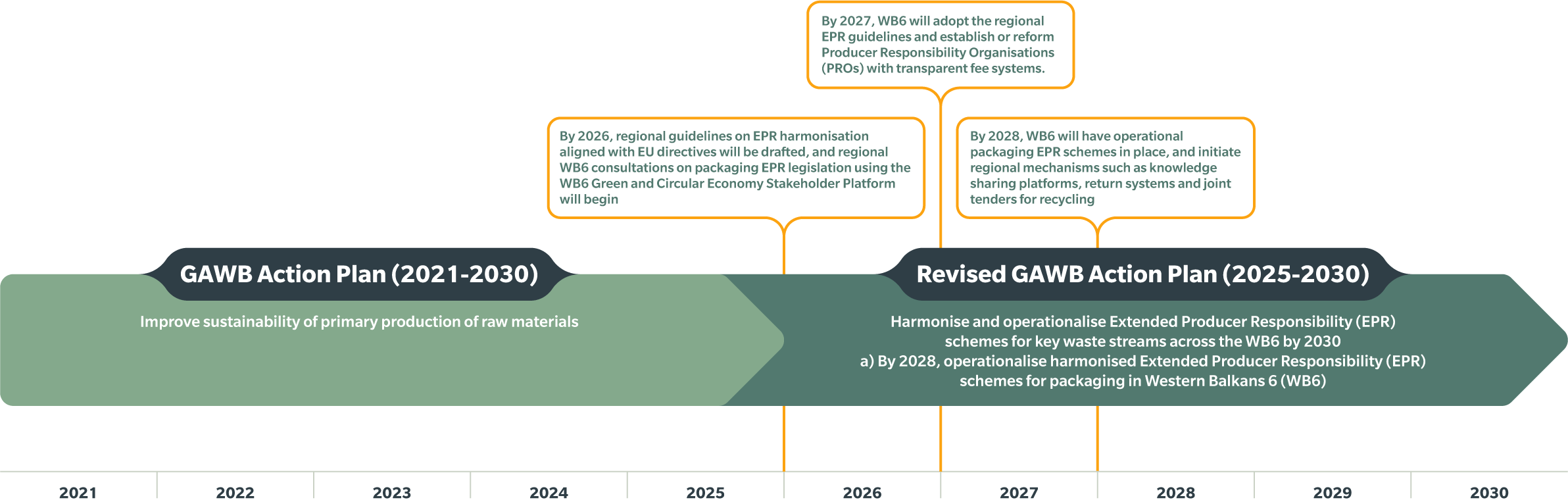
Action 19a) focuses on operationalising harmonised Extended Producer Responsibility schemes for packaging across the WB6, as a basis for strengthening waste prevention, collection, recycling performance and alignment with EU requirements.
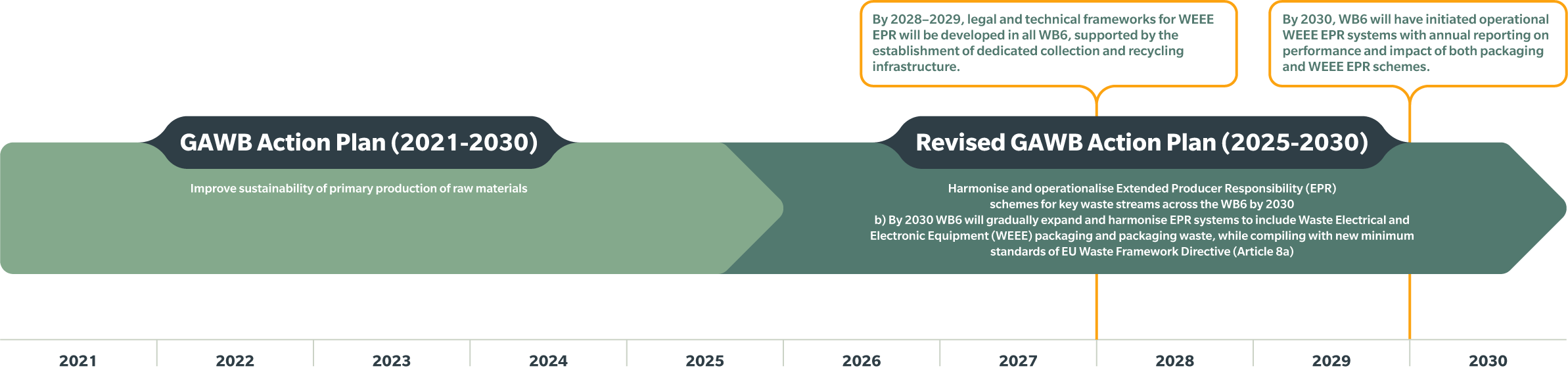
Action 19b) addresses the gradual expansion and harmonisation of EPR systems across the WB6 to include WEEE by 2030, in line with the minimum requirements set out in Article 8a of the Waste Framework Directive.
Option A: WB6 statistical offices
Option B: Eurostat
Comparing the two options above: Albania is the only visible difference, because Eurostat has not yet received its 2024 figure. Everywhere else, the two bases differ by less than 0.2 per cent of the scale, at most 283 thousand tonnes for North Macedonia in 2024, and the bars are identical to the eye.
Source: WB6 statistical offices. Albania: INSTAT, Material Flow Account, 2023 (23 April 2025) and Material Flow Account, 2024 (23 April 2026). Bosnia and Herzegovina: Agency for Statistics of Bosnia and Herzegovina, Material Flow Accounts, 2024 (7 July 2026) and Resource Productivity, 2023 (11 July 2025) and 2024 (13 July 2026). North Macedonia: Statistical Office, economy-wide Material Flow Accounts, releases of 29 November 2024 and 28 November 2025, with the figure per capita derived from those totals and the Office’s population estimates of 1,826,247 at 31 December 2023 (North Macedonia in Figures, 2024) and 1,822,612 at 31 December 2024 (North Macedonia in Figures, 2025), as the Office publishes no figure per capita. Serbia: Statistical Office, Material Flow Indicators, 2024 (5 December 2025).
Note: 2025 data is not available. Domestic material consumption is compiled from economy-wide Material Flow Accounts, which the WB6 statistical offices report to Eurostat with a minimum two-year lag. Each of the WB6 is shown in its own statistical office’s figures for both years and both graphs. Where an office publishes a total but no figure per capita, the figure per capita is derived from that office’s own total and its own population estimate; this applies to North Macedonia only. Albania’s 2024 total is published as 25.4 million tonnes, and Bosnia and Herzegovina’s figures per capita as approximately 10.3 and 10.8. Kosovo* and Montenegro do not compile economy-wide Material Flow Accounts.
Option A: WB6 statistical offices
Option B: Eurostat
Comparing the two options above: Albania is again the only visible difference. Its 2023 figure falls from 9.0 to 7.861 tonnes because Eurostat still divides by the pre-census population, and its 2024 bar is absent. The others differ by no more than 0.13 tonnes, which does not show at this scale.
Source: WB6 statistical offices. Albania: INSTAT, Material Flow Account, 2023 (23 April 2025) and Material Flow Account, 2024 (23 April 2026). Bosnia and Herzegovina: Agency for Statistics of Bosnia and Herzegovina, Material Flow Accounts, 2024 (7 July 2026) and Resource Productivity, 2023 (11 July 2025) and 2024 (13 July 2026). North Macedonia: Statistical Office, economy-wide Material Flow Accounts, releases of 29 November 2024 and 28 November 2025, with the figure per capita derived from those totals and the Office’s population estimates of 1,826,247 at 31 December 2023 (North Macedonia in Figures, 2024) and 1,822,612 at 31 December 2024 (North Macedonia in Figures, 2025), as the Office publishes no figure per capita. Serbia: Statistical Office, Material Flow Indicators, 2024 (5 December 2025).
Note: 2025 data is not available. Domestic material consumption is compiled from economy-wide Material Flow Accounts, which the WB6 statistical offices report to Eurostat with a minimum two-year lag. Each of the WB6 is shown in its own statistical office’s figures for both years and both graphs. Where an office publishes a total but no figure per capita, the figure per capita is derived from that office’s own total and its own population estimate; this applies to North Macedonia only. Albania’s 2024 total is published as 25.4 million tonnes, and Bosnia and Herzegovina’s figures per capita as approximately 10.3 and 10.8. Kosovo* and Montenegro do not compile economy-wide Material Flow Accounts.