

Action 30
Apply an industrial ecosystem approach to attain environmentally sustainable, balanced economic recovery
ROADMAP PROGRESS
The 2025 GARI indicates that the industrial transition of the WB6 should go beyond traditional industrial policy measures and explicitly align domestic industrial policies and support schemes with the objectives of the new Industrial Strategy for Europe, including the twin green and digital transition, stronger resilience of industrial ecosystems and deeper participation in EU Single Market value chains. The life cycle approach remains central to the EU’s sustainability and industrial transition agenda.
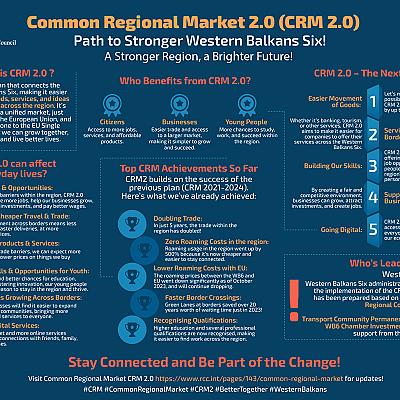
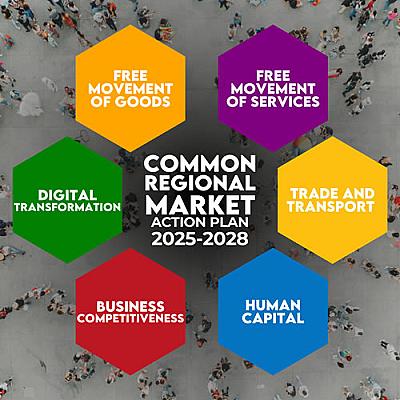
The new Common Regional Market Action Plan 2025–2028 (CRM 2.0), adopted in October 2024, provides an important regional cooperation framework for supporting competitiveness, market integration and elements of the green and digital industrial transition in the WB6, although implementation remains uneven across the WB6. The start of the CBAM definitive regime on 1 January 2026 has increased the urgency of industrial decarbonisation, particularly for exporters of electricity, iron and steel, aluminium, cement, fertilisers and hydrogen-related value chains, and a CEE Bankwatch Network report of October 2025 warned that insufficient preparation by WB6 administrations could create a perfect storm, as carbon-intensive exports, particularly electricity, will face significant costs.
Throughout 2025, the WB6 took varied steps to adapt their industrial policies. Montenegro recorded notable progress, adopting an action plan for its 2024-2028 industrial policy in June 2025, updating the Competitiveness Council’s plan in March 2025 to address business barriers, and adopting a waste management plan for 2025-2029. Serbia continued implementing its 2021- 2030 Industrial Development Strategy and adopted a new SME strategy for 2025–2030 in August 2025, building on its regional leadership in green finance established with its 2024 ESG bond, although challenges in waste management persisted and several landfill fires occurred in the summer of 2025 despite the adoption of a new waste prevention plan. Albania advanced its Business and Investment Development Strategy and signed a cooperation agreement on 22 May 2025 to develop eco-industrial parks with support from the EU and the International Finance Corporation (IFC), while significant progress is still needed on littering, integrated waste management legislation and extended producer responsibility.
In Kosovo*, the comprehensive 2023-2030 strategy for industrial development and business support continued, although with an implementation rate below 40%. Positive steps included the start of the beneficial ownership register in August 2025 and the transformation of two industrial parks into eco-industrial areas, while access to finance for SMEs improved markedly, with the Kosovo* Credit Guarantee Fund enabling loans worth EUR 944.2 million by September 2025. North Macedonia adopted a new development strategy for 2024-2044 and a new SME strategy for 2025-2030, but the implementation of circular economy principles was reported as stagnating, and the Fund for Innovations and Technological Development was closed following findings of irregularities and a subsequent restructuring of support mechanisms. In Bosnia and Herzegovina, the absence of a coherent domestic industrial policy strategy remains a major obstacle to applying an integrated industrial ecosystem approach, given fragmented competences and uneven legislative alignment across levels of governance. At the entity-level of Bosnia and Herzegovina, the Republika Srpska enacted an SME Innovation Action Plan and the Federation of Bosnia and Herzegovina adopted a sectoral strategy for textiles. However, the overall alignment with the EU acquis, particularly the Small Business Act and the Late Payment Directive, is incomplete.
The shift towards more sustainable production systems continues to be shaped by developments in EU regulatory frameworks, including the Ecodesign for Sustainable Products Regulation (ESPR), which entered into force on 18 July 2024 and provides a key framework for making sustainable products the norm. The adoption of the first ESPR and Energy Labelling Working Plan for 2025-2030 in April 2025 further clarified the EU ambition to make sustainable products the norm, prioritising high-impact product groups such as textiles, furniture and electronics alongside horizontal measures for future eco-design and information requirements. These requirements on durability, reparability and resource efficiency present a compliance challenge for WB6 industries and, at the same time, an opportunity for modernisation and integration into EU value chains. At regional level, several initiatives in 2025 aimed to accelerate the green industrial transition. The OECD continued its project on Digitalising and Greening SMEs in the Western Balkans and hosted a Regional Peer Dialogue on Industrial Symbiosis. The Western Balkans Investment Framework pilot project on eco-industrial parks also gained momentum, with workshops for Serbia’s first greenfield park in Šabac and the finalisation of the agreement for pilot projects in Albania. In parallel, the RCC, in cooperation with UNIDO and other partners, launched technical assistance to identify industrial symbiosis opportunities through eco-industrial parks in the WB6, supporting the gradual development of more resource-efficient industrial zones in the region. In addition, a new Go Digital in the Western Balkans programme was launched by the EBRD and the EU to support SME digitalisation and green technology adoption.
In summary, while the WB6 are making unequal progress in adapting their industrial ecosystems, the strategic direction is clear. The combination of EU regulatory drivers such as ESPR and CBAM, coupled with targeted regional support for eco-industrial parks, SME greening and circular economy roadmaps, is creating a strong impetus for change. The key challenge for 2026 will be to translate these strategies and pilot initiatives into broader and more systematic implementation, so as to ensure that industries across the region remain competitive in an increasingly green European market.

Note: Action 30 of the first Green Agenda Action Plan (2021–2030) is not retained as a standalone action in the Revised Action Plan (2025–2030). Its measures are integrated into the Common Regional Market (CRM) framework, including activities on Digital Product Passports, Green Public Procurement, and the promotion of industrial symbiosis and eco-industrial parks.