

Action 26
Promote preparation and implementation of Sustainable Urban Mobility Plans for urban areas in the Western Balkans
ROADMAP PROGRESS
The GARI 2025 notes continued progress in developing Sustainable Urban Mobility Plans (SUMPs) across the WB6, supported by GIZ, UNDP, Interreg, ADRION and World Bank and AFD-funded programmes. SUMPs are increasingly used to guide emission reduction, active mobility, inclusive and safe transport, and alignment with the Sustainable and Smart Mobility Strategy for the Western Balkans. In Serbia, five cities have officially adopted SUMPs and a further eight are in preparation, with additional plans planned for 28 cities under the Local Infrastructure and Institutional Development Project. In North Macedonia, the World Bank is supporting SUMP preparation in five municipalities, with the initial institutional, baseline-assessment and scenario-development stages completed and final adoption planned for 2026. In Albania, a formal SUMP for Tirana is being prepared with GIZ support, alongside ongoing measures involving electric buses, cycling infrastructure, pedestrianisation and a planned Bus Rapid Transit system. Montenegro is also updating its Transport Development Strategy to strengthen coherence between domestic transport planning and local SUMP initiatives.
The revised TEN-T framework (EU Regulation 2024/1679) establishes urban-mobility requirements for designated urban nodes, generally covering cities with more than 100,000 inhabitants. The designation of urban nodes in the WB6 is still under way. Once designated, the relevant nodes will be expected to adopt SUMPs for their functional urban areas by 2027 and establish multimodal passenger hubs by 2030 to improve first- and last-mile connectivity.
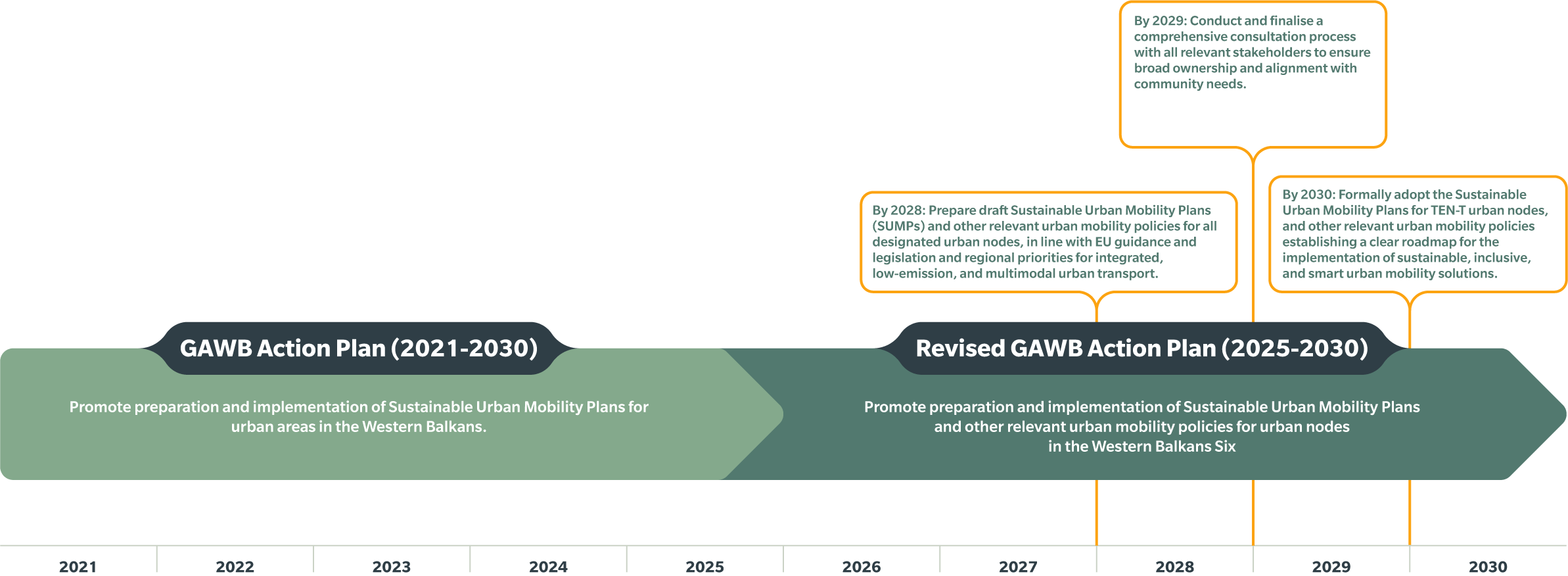
Note: Action 26 of the first Green Agenda Action Plan (2021–2030), which promotes the preparation and implementation of Sustainable Urban Mobility Plans (SUMPs) for urban areas, is retained in the Revised Action Plan (2025–2030) as Action 17, expanding the scope from general urban areas to TEN-T urban nodes and other relevant urban mobility policies in line with EU transport and TEN-T requirements.