

Action 20
Define an overall strategy to shift traffic from road to more environmentally friendly modes
ROADMAP PROGRESS
The GARI 2025 reports continued progress in establishing the strategic, regulatory and investment foundations for a future shift from road transport towards cleaner and more sustainable modes. Implementation is being pursued through the Sustainable and Smart Mobility Strategy, sustainable urban mobility planning, alternative-fuels infrastructure, gradual fleet renewal, rail-freight integration and the development of multimodal transport connections. Progress under related actions on railway reform, infrastructure modernisation, freight corridors and cross-border/boundary facilitation is expected to support this longer-term shift.
The Sustainable and Smart Mobility Strategy, grounded in the European Green Deal and the objective of climate neutrality by 2050, provides the regional framework for aligning transport policies, investment and infrastructure development with EU standards. The 2025 reporting period marked a continued transition from planning to implementation, with WB6 increasingly incorporating sustainability, digitalisation and climate resilience into transport planning. Nevertheless, progress remains uneven, and significant gaps persist in legislative alignment, financing and institutional capacity.
At domestic level, Albania was preparing its Sectoral Transport Strategy 2030, while Montenegro was updating its Transport Development Strategy 2019–2035 and the accompanying Action Plan. North Macedonia prepared a progress report and draft revision of its Transport Strategy 2018–2030. Bosnia and Herzegovina’s revised Framework Transport Strategy had still not been formally adopted by the end of 2025. Serbia continued implementing its Transport Strategy 2023–2030, which includes increasing the use of rail and public transport among its modal-shift objectives.
Further progress requires accelerated railway reform, stronger multimodal freight and passenger integration, more efficient logistics, expanded sustainable urban mobility measures and targeted investment in low-emission transport infrastructure. It also requires addressing bottlenecks in modal interconnections and reviewing existing incentive systems so that policy commitments translate into measurable reductions in dependence on road transport.
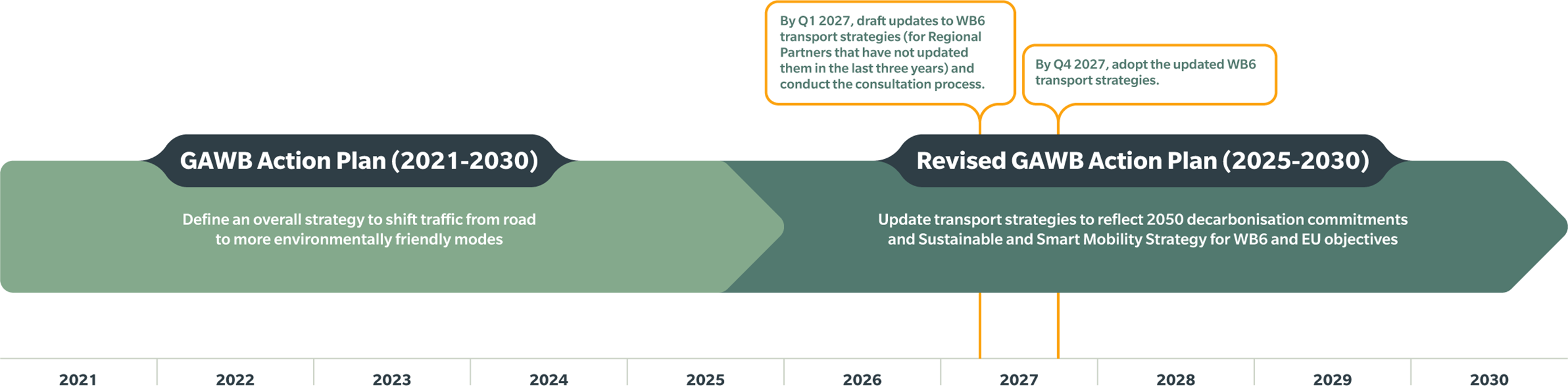
Note: Action 20 of the first Green Agenda Action Plan (2021–2030), which envisaged defining an overall strategy to shift traffic from roads to more environmentally friendly modes, is not retained as a standalone action in the Revised Action Plan (2025–2030). Elements related to modal shift are integrated into revised actions addressing rail reform, sustainable urban mobility, alternative fuel infrastructure and alignment with the EU transport acquis.