

Action 46
Promote environmentally friendly (zero pollution) and organic farming and reduction of synthetic chemical products used in food production
ROADMAP PROGRESS
The 2025 GARI describes organic agriculture in the WB6 as an emerging sector with slow but steady growth, accounting for around 0.13% of total agricultural land, well below the 25% target set under the European Green Deal. Output is largely export-oriented to the EU and the United States, with limited domestic sales. The main barriers include limited know-how, underdeveloped value chains, soil contamination and weak institutional support, such as control laboratories. All WB6 have transposed elements of the earlier EU organic regulations and are drafting or updating legislation to align with Regulation (EU) 2018/848, with action plans prepared through the Regional Expert Advisory Working Group. Serbia adopted a new Law on Organic Production in December 2025, aligned with Regulation (EU) 2018/848.
On agri-environmental pressures, the 2025 GARI records that although all WB6 have committed to implementing the Nitrates Directive, very few efforts have been made in this direction: none has designated Nitrate Vulnerable Zones or prepared an action plan to prevent and reduce nitrate pollution from agricultural practices, and none has introduced measures such as crop rotation, lower nitrogen application rates, or improved storage and handling of manure. Reported data on the agricultural use of fertilisers are inconsistent, which the Report suggests may reflect small and fragmented farms, changes in policy frameworks including reduced subsidies for crop nutrients, price shocks, and drought.
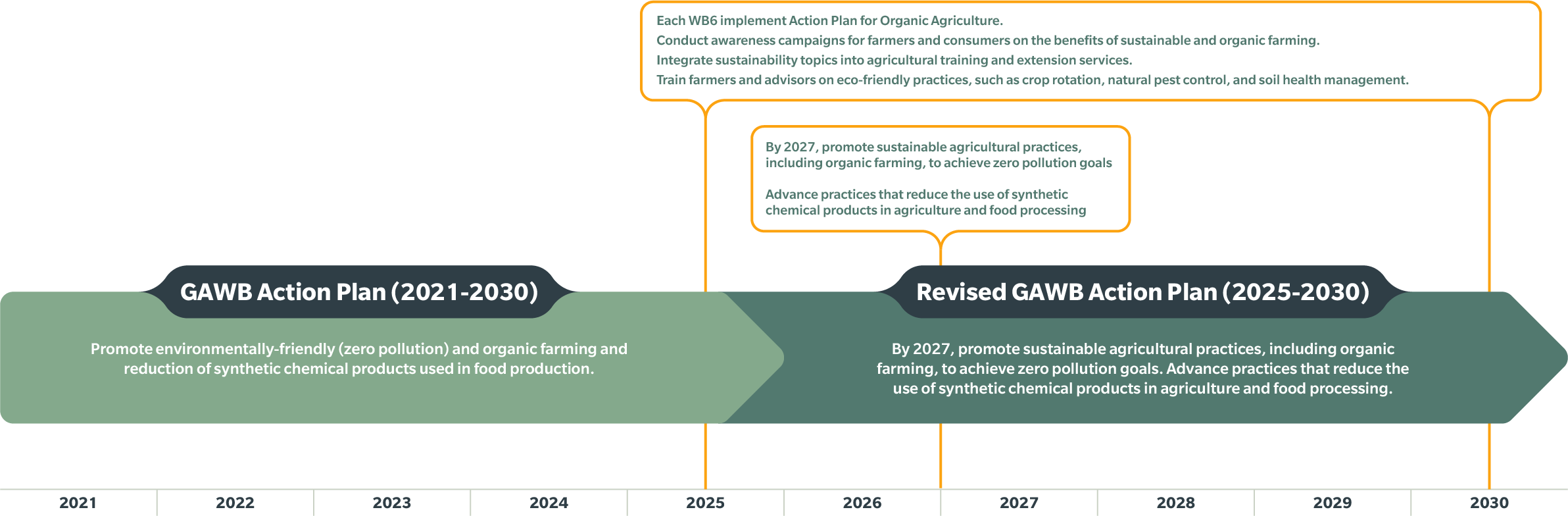
Note: Action 46 of the first Green Agenda Action Plan (2021–2030) is reflected in the Revised Action Plan (2025–2030) under Action 31. The revised action broadens the focus from promotion of organic farming alone to the wider adoption of sustainable agricultural practices aligned with zero-pollution objectives, including reduction of synthetic chemical inputs in agriculture and food processing. The revised framework emphasises practical measures and timelines for advancing environmentally-friendly farming systems by 2027.
Source: FiBL and IFOAM - Organics International, The World of Organic Agriculture: Statistics and Emerging Trends 2026. Data reproduced in RCC (2025) Report on the Implementation of the Green Agenda for the Western Balkans Action Plan (GARI 2025), Table 18.
Source: Statbase (2026) Agricultural Use of Fertilizers by Nutrient, Global Data and Statistics Hub. Data reproduced in RCC (2025) Report on the Implementation of the Green Agenda for the Western Balkans Action Plan (GARI 2025), Table 19.
Note: Note: Figures are tonnes of nutrients, comprising nitrogen, phosphate and potash. Kosovo* is not reported in the source table, and the 2025 GARI notes that the reported data are inconsistent.