

Action 38
Establish an adequate air quality monitoring system, including by accrediting air quality monitoring networks
ROADMAP PROGRESS
According to the 2025 GARI, many WB6 cities continue to experience air pollution above EU limit values and WHO guidelines, with total premature deaths attributable to PM2.5 in the main WB6 cities estimated at between 4,600 and 5,300 in 2019. Each WB6 is assessing monitoring capacity and developing targeted measures. Albania's network remains limited to seven automatic stations, several non-operational owing to maintenance funding constraints. Bosnia and Herzegovina operates 31 automatic stations in the entity of Federation of Bosnia and Herzegovina and seven in the entity of Republika Srpska but still requires a domestic-level air quality strategy and strengthened administrative capacity. In Montenegro, monitoring is carried out at nine automatic stations across three zones by an accredited domestic-level reference laboratory. In North Macedonia there were no legislative developments and monitoring capacity remains constrained. In Kosovo*, no progress was recorded and emissions of SO₂, NOx and dust increased in 2024. Serbia adopted a new Law on Air Protection in June 2025 and, through an IPA project, installed nine new stations and upgraded instruments at 31 existing stations for automatic PM10 and PM2.5 measurement. Under the EU4Green project, work continues on air quality plans and on establishing domestic Reference Laboratories (NRLs) in all WB6, following the precedent set by Montenegro.
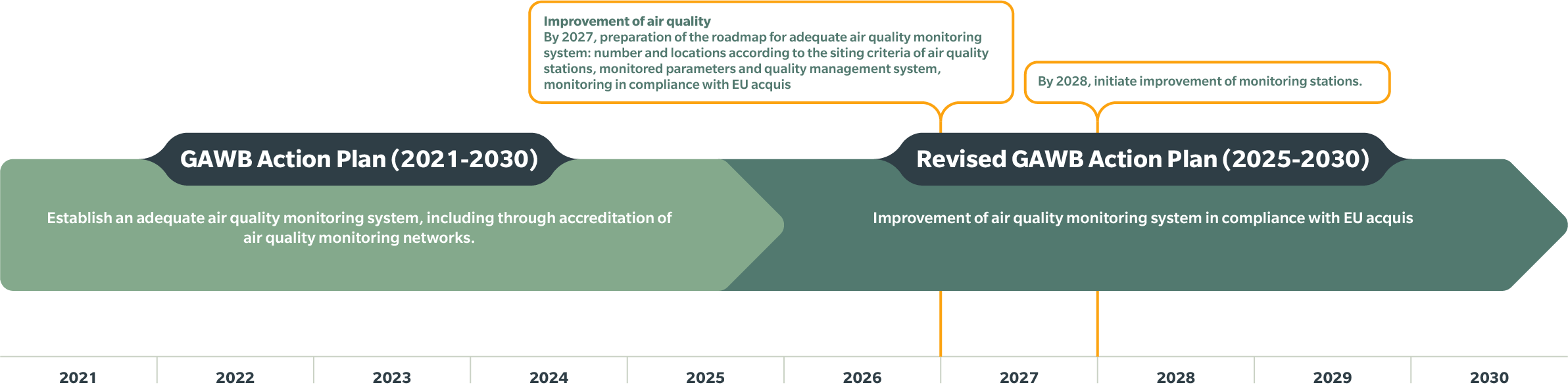
Note: Action 38 of the first Green Agenda Action Plan (2021–2030) is retained in the Revised Action Plan (2025–2030) as Action 25, which focuses on improving air quality monitoring systems in line with the EU air pollution acquis, including the development of monitoring networks and the upgrading of monitoring infrastructure.