
Action 35
Further implement Smart Specialisation Strategies, place-based, innovation-led transformation agendas for sustainability

ROADMAP PROGRESS
The 2025 GARI reports that the implementation of Smart Specialisation Strategies (S3) and place-based, innovation-led transformation agendas for sustainability across the WB6 remained uneven and predominantly at an early to intermediate stage in 2025. While some WB6 have advanced their S3 processes significantly, others continue to face structural challenges in translating strategic priorities into operational programmes and concrete investments. The broader context of EU accession and the increasing alignment of WB6 with EU innovation and cohesion policy frameworks has provided important external motivation for advancing S3 implementation.
Albania adopted its Smart Specialisation Strategy 2025-2030 in December 2024, pursuant to Council of Ministers Decision No. 824, accompanied by a costed Action Plan and an Interministerial Committee led by the Deputy Prime Minister. The strategy identifies six priority areas through an Entrepreneurial Discovery Process: Agriculture/Fishing/Forestry, Manufacturing Industry, Energy with a renewable emphasis, Tourism, ICT and Business Process Outsourcing. Cross-sectoral priorities include the Blue Economy and Renewable Energy Resources. In 2025, implementation frameworks were put in place, and the EIT Raw Materials Regional Innovation Centre in Elbasan, which became fully operational in 2025, organised the first Raw Materials Community Dialogue in May 2025, anchoring a regional cluster around sustainable raw materials. Research and development (R&D) spending stood at 0.19% of GDP against a 2030 target of 1%. Bosnia and Herzegovina continued to face major structural obstacles. Fragmented competences and weak coordination across Bosnia and Herzegovina continued to limit progress. The 2025 Enlargement Package concluded that no progress was made, research capacities remained very limited and R&D spending remained below 0.3% of GDP. Its complex institutional architecture, with no umbrella competence over research or industrial policy, continues to prevent a coherent S3. The European Innovation Scoreboard placed Bosnia and Herzegovina at 33.1% of the EU average. Kosovo* does not yet have a formal Smart Specialisation Strategy. Selected innovation and industrial development initiatives continued to support elements of place-based transformation. The Innovation and Training Park (ITP) Prizren consolidated its position, welcoming 14 new tenant companies to reach 60 companies with approximately 478 employees under the 2023 Law on Industrial and Technological Parks, with EUR 33 million allocated for 2024–2026. Kosovo* also signed a Free Trade Agreement with the European Free Trade Association (EFTA) in March 2025, while GIZ continued to support the innovation ecosystem, including innovation skills and sustainability activities at ITP Prizren. However, there is no evidence of S3-aligned prioritisation or a formal Entrepreneurial Discovery Process underway. Montenegro, the first of the WB6 to adopt an S3 in June 2019, completed its first full implementation cycle in 2025 and launched preparation of a new strategy for 2026- 2031. Montenegro’s Industrial Policy 2024–2028 was adopted in August 2024. The provisional closure of EU accession Chapter 20 (Enterprise and Industrial Policy) in December 2024 formally recognised this progress. In December 2025, Montenegro provisionally closed five additional EU accession chapters, bringing the total to 12 out of 33. The Innovation Fund of Montenegro and the Council for Innovation and Smart Specialisation remained active, while first and second disbursements under the EU Reform and Growth Facility were approved in July and October 2025, respectively.
North Macedonia saw active implementation of its 2024-2027 strategy, with public funding for science increasing to EUR 11 million, a 58% increase over 2024, of which EUR 5.5 million was earmarked for S3 key initiatives, although the Fund for Innovation and Technological Development was closed in August 2025 and replaced by a new agency established under a new Law on Innovation Activity, Scientific and Technological Development and Entrepreneurship. North Macedonia also established its European Digital Innovation Hub (EDIH) and led the WB6 in EIT Jumpstarter 2025 submissions with 23 applications. Serbia is in its fifth year of implementation, with over 70% of first Action Plan activities completed, a Science Fund maintaining 13 funded programmes with a total budget of EUR 106.5 million and R&D investment of 0.88% of GDP in 2023. At the regional level, the Common Regional Market Action Plan for 2025-2028 (CRM 2.0) provides an important cooperation framework for market integration, competitiveness and elements of green and innovation-led transformation, including those relevant to S3 implementation and industrial ecosystem development.
The most notable 2025 development was the advancement of three eco-industrial park pilots in Serbia under the EU and IFC programme, supported by a EUR 3.6 million WBIF grant: the greenfield park in Šabac, the first greenfield eco-industrial park in the WB6, the MIND Park brownfield project in Kragujevac, the first brownfield eco-industrial park in the region, and the Marera Industrial Park Pobeda in Novi Sad. This consolidated Serbia’s position as the most advanced among the WB6 in translating S3 into operational innovation investments. The EBRD and EU Go Digital in the Western Balkans programme, launched in April 2025 with EUR 377 million in total financing and targeting approximately 750 businesses, addresses the 20-percentage point gap in digital intensity between SMEs in the region and their EU peers, with first operational loans signed in 2025 with NLB Banka Skopje and ProCredit Bank Bosnia and Herzegovina. EIT Community Hubs were launched in Albania in February 2025 and in Serbia in October 2025, and EIT Jumpstarter 2025 received 82 submissions from the WB6, approximately 10% of the global total. The SMART Project, implemented from 2022 to 2025 under the Erasmus+ Capacity Building in Higher Education programme, brought together fourteen partner institutions from Albania, Bosnia and Herzegovina, Montenegro, Slovenia, Italy and Germany and aimed to strengthen the role of higher education institutions as drivers of regional innovation and smart specialisation. The project established seven SMART Innovation Centres across partner universities in Albania, Bosnia and Herzegovina and Montenegro. Guided by the Quintuple Helix innovation model, the project built capacity through training workshops, student innovation contests, university–industry counselling and the creation of a regional SMART Knowledge Exchange Network. The project held its final conference on 23 October 2025 at the University of Donja Gorica in Podgorica. The defining regional challenge remains to move from the formal adoption of S3 strategies to their effective implementation through measurable, place-based transformation results.
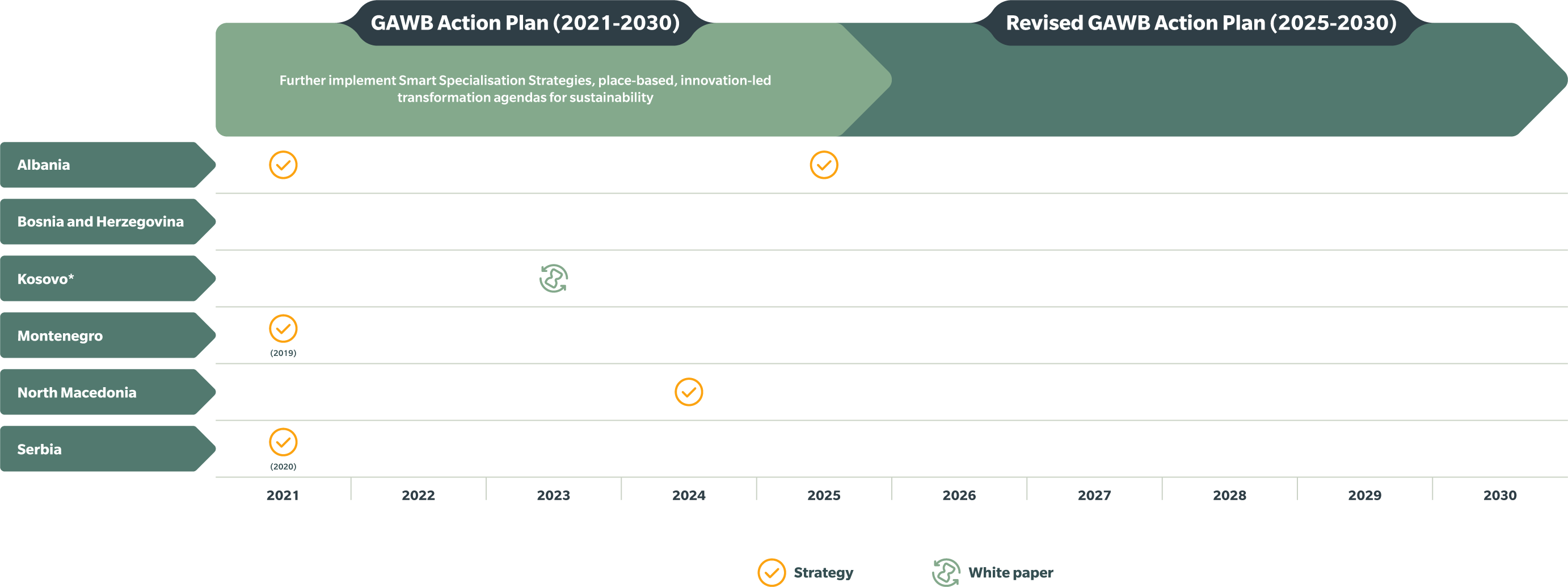
Note: Action 35 of the first Green Agenda Action Plan (2021–2030) is not retained as a separate action in the Revised Action Plan (2025–2030). Its objectives are addressed through the Common Regional Market (CRM 2.0) framework, which supports regional cooperation on smart specialisation priorities and innovation initiatives.