

Action 32
Make further progress in the construction and maintenance of waste management infrastructure for cities and regions
ROADMAP PROGRESS
The 2025 GARI reports that the WB6 made tangible, albeit uneven, progress in modernising their waste management infrastructure in 2025, a critical step in aligning with EU environmental standards and advancing the circular economy. Beyond the construction of physical facilities, effective waste management infrastructure depends on sound operational practices, clear governance arrangements and predictable financing systems, and the Roadmap calls for a shift away from the linear “collect and dispose” model towards integrated systems that prioritise waste prevention, separate collection, treatment and recycling within sustainable funding frameworks. Investment in modern infrastructure remains heavily reliant on the EU and the Western Balkans Investment Framework (WBIF).
At the WB6 level, progress in building physical infrastructure has not yet been matched by reforms in governance and financing. Municipal waste services remain constrained by fragmented institutional responsibilities, underfunded environmental agencies and tariffs that rarely cover the full cost of collection and treatment. Across the WB6, a large share of municipal waste continues to be disposed of in non-sanitary or illegal landfills with little or no pre-treatment, and gate fees, where they exist, often cover only basic operations and do not incentivise separate collection or waste prevention. As a result, many waste management systems remain locked in a low-investment, low-performance equilibrium. As municipal waste generation continues to rise, the share of municipal waste sent to landfill remains more than 3.5 times higher than the EU average, making waste disposal the weakest area of performance within the greening cluster. The Roadmap underlines the need for reforms across the WB6 that clarify responsibilities, strengthen enforcement and establish predictable, polluter-pays-based funding models to support integrated waste management systems, including through the gradual roll-out and improvement of EPR schemes for packaging, waste electrical and electronic equipment (WEEE) and other priority streams across the region.
Several landmark investments were delivered in 2025. In Bosnia and Herzegovina, the Živinice solid waste management centre officially began operations in April 2025. This EU-compliant sanitary landfill and recycling facility serves approximately 95,000 residents and was financed through a EUR 5 million EBRD loan together with grants from Sweden and the EU. Early operational experience indicates that the facility has started to reduce reliance on unsanitary dumpsites in its service area and has enabled basic recycling activities, although its performance remains contingent on improving separate collection, ensuring stable cost recovery through tariffs and strengthening institutional capacity for its long-term effectiveness. In North Macedonia, a EUR 2 million WBIF grant for technical assistance to prepare the second phase of the Regional Solid Waste Management Project was signed in July 2025, as part of a broader package including a EUR 55 million EBRD loan and a EUR 21.7 million EU grant, which aims to establish modern waste management systems for more than one million residents across 45 municipalities. In January 2026, North Macedonia inaugurated new waste selection equipment for 18 municipalities in the Pelagonija and Southwestern regions, a EUR 11 million investment linked to the future regional waste management centre in Novaci and transfer stations in Prilep, Ohrid, Kičevo and Debar, as part of a EUR 60 million regional waste management system supported through the WBIF. Preparations also continued for the construction of regional landfills and transfer stations under the broader EU- and EBRD-supported Regional Solid Waste Management Project, aimed at establishing integrated and EU-compliant waste management services across multiple regions.
Serbia’s Belgrade waste-to-energy facility in Vinča became fully operational in 2025, processing 340,000 tonnes of waste annually to generate electricity and heat. While this reduces landfill dependency, it has also intensified discussion of whether investment in incineration risks diverting resources from higher-priority measures such as waste prevention, separate collection and recycling. Civil society organisations, including Bankwatch, raised concerns that incineration could undermine recycling targets and lock the region into a carbon-intensive model. These concerns were amplified during the summer of 2025, when the closure of the Duboko waste management centre led to waste being redirected to unsanitary landfills and to several major landfill fires. In Montenegro, trial operations began in December 2025 at the biogas power plant at the Možura regional landfill, the first of its kind in the WB6. The 1.5 MW facility converts landfill gas into electricity, supplying the equivalent of 400 households and demonstrating a viable alternative to flaring. The adoption of the Waste Management Plan (2025–2029) further strengthened Montenegro’s strategic direction towards reducing landfill reliance. Albania announced a major reform of its waste sector in August 2025 to centralise waste management under a new domestically owned operator by 2026. While key legislation on integrated waste management remains pending, progress is visible on the ground, with 15 municipalities introducing composting and Material Recovery Facilities (MRFs), and a pilot project for waste separation at source running in Berat. In Kosovo*, despite the approval of an integrated waste management strategy in late 2024, the number of identified illegal dumpsites increased by 13.6% during the reporting period, from 403 in 2024 to 458 in 2025. Progress has also been constrained by limited financial resources for investment in sanitary landfills and waste pre-treatment and treatment facilities, both through the budget and external financing mechanisms. The Integrated Waste Management Strategy 2024-2035 estimates that approximately EUR 500 million in investments will be required over the next decade to meet landfill diversion and recycling targets. Continued delays in approving and implementing inter-municipal waste management plans have further slowed the development of regional waste management systems. Delays in implementing the deposit return system (DRS), together with the pending approval of inter-municipal waste management plans, have further underscored the need for stronger enforcement and administrative capacity. The divergence between formal strategic objectives and implementation on the ground continues to highlight persistent financing, governance and institutional capacity challenges in the waste management sector.
Overall, 2025 demonstrated that while the WB6 are capable of delivering complex, EU-compliant waste infrastructure projects with international support, significant challenges remain. The lack of reliable waste data, persistent underfunding at the municipal level and the need for greater public engagement in waste separation remain common hurdles. Moving forward, a dual focus on constructing new facilities and strengthening the operational and governance frameworks needed to manage them will be essential for a sustainable transition.
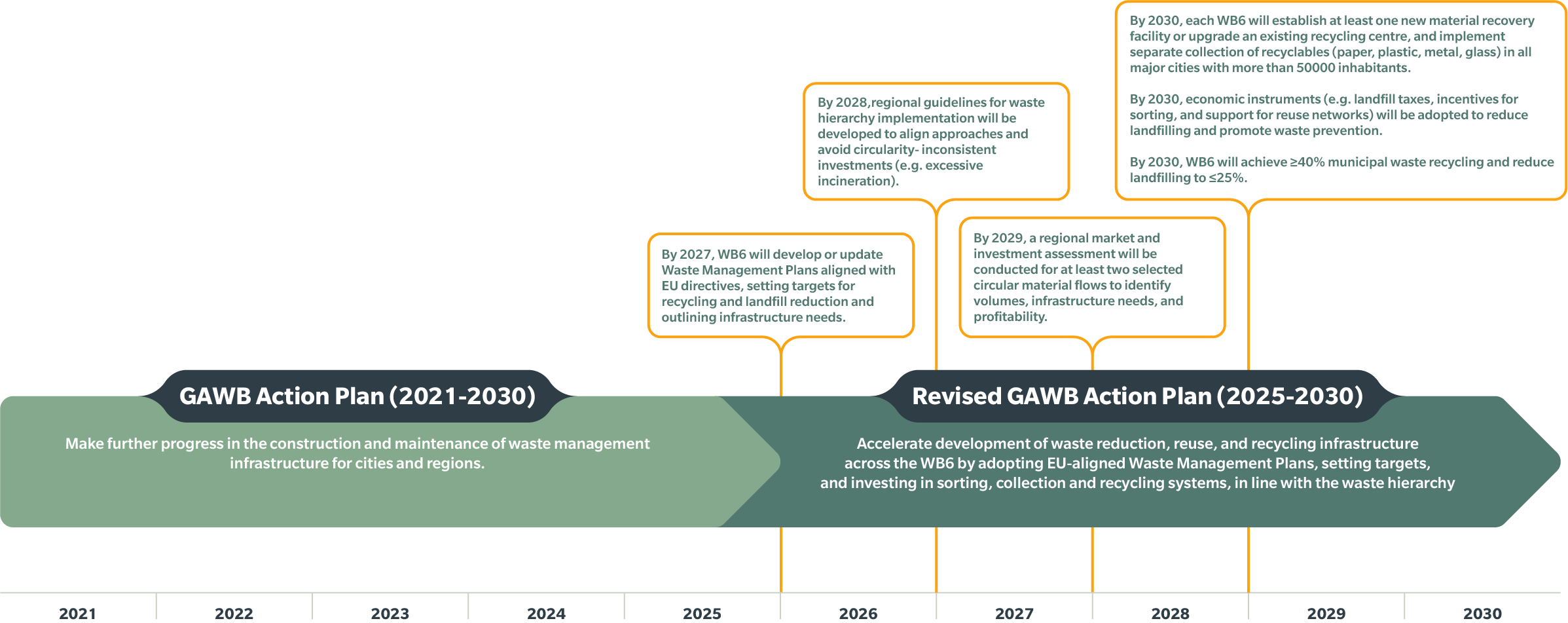
Note: Action 32 of the first Green Agenda Action Plan (2021–2030), which focused on the construction and maintenance of waste management infrastructure, is retained in the Revised Action Plan (2025–2030) as Action 20, with a broader and more operational focus on accelerating waste reduction, reuse and recycling infrastructure across the WB6, in line with the EU waste hierarchy.