

Action 25
Develop and implement climate resilience plans for Western Balkans` transport networks
ROADMAP PROGRESS
The GARI 2025 shows progress across the WB6 in integrating climate resilience into transport planning, infrastructure design and EU funding proposals, supported by technical assistance from CONNECTA and the Transport Community Secretariat. In the related Road Action Plan pillar combining climate resilience and alternative-fuels infrastructure, the regional implementation rate stood at 31%. Transport infrastructure remains highly vulnerable to floods, landslides, high temperatures, sea surges and snowdrifts. Vulnerability assessments indicate that nearly 56% of road networks and 34% of railway links in the northern WB6 are highly exposed under both 2030 and 2050 scenarios, and the top 20 most vulnerable road and rail segments have been identified for each of the WB6 to guide priority interventions.
Concrete measures continued during 2025. Albania advanced the reconstruction of 27 priority bridges under the World Bank’s Resilient Bridges project and operationalised guidelines and methodologies for climate-vulnerability assessment. Bosnia and Herzegovina incorporated resilience considerations into selected TEN-T corridor sections, while Kosovo* integrated risk-assessment methodologies into its MMTS 2023–2030. Montenegro is developing a Road Infrastructure Climate Resilience Strategy and accompanying Action Plan with EBRD support. North Macedonia is increasingly integrating resilience into detailed road design and developing legislation on natural hazards and adaptation. Serbia expanded its Road Weather Information System to 81 operational units, supporting early warning, preventive maintenance and climate-responsive operations.Climate resilience planning is increasingly integrated into road and railway design, TEN-T corridor management and project funding, particularly for high-risk infrastructure segments. Nevertheless, further progress is required to fully operationalise Resilience Action Plans, implement targeted interventions and harmonise legislation so that climate adaptation is embedded across road, rail and maritime transport systems.
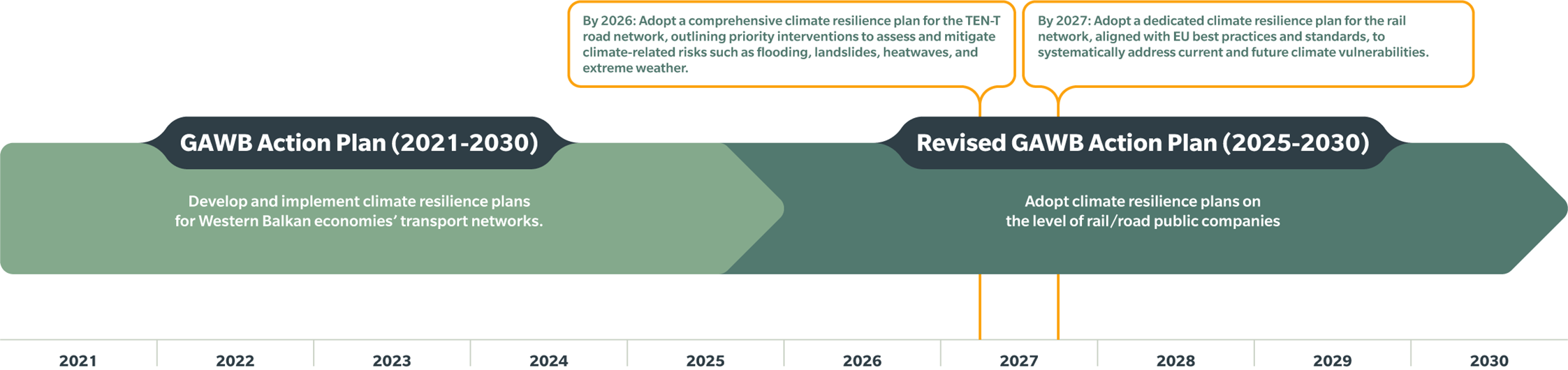
Note: Action 25 of the first Green Agenda Action Plan (2021–2030) is reformulated in the Revised Action Plan (2025–2030) as Action 16, narrowing the focus from regional transport network resilience to the adoption of climate resilience plans by rail and road public companies.