
Action 18
Implement the Regional Action Plan for Rail Reforms
ROADMAP PROGRESS
According to the GARI 2025, implementation of the Regional Railway Reform Action Plan has progressed unevenly across the WB6. The average implementation rate standing at 58%, a decrease on the 66% recorded in 2024. Reform efforts have focused on continued alignment with the EU railway acquis, particularly market opening, infrastructure governance, interoperability and safety. Overall railway-market openness stands at 62%, with eighteen private freight operators active across the region, while the markets in North Macedonia and Bosnia and Herzegovina remain closed.
During the reporting period, Montenegro adopted a new Railway Law and established a new Railway Agency combining regulatory and safety functions. Albania established a Railway Regulatory Agency and, through the 2024 Separation Act, legally divided its domestic railway company (HSH) into separate infrastructure and operational entities. In Bosnia and Herzegovina, the public railway operator of the Entity of Republika Srpska began functioning as a holding company from January 2025 with internal separation of infrastructure and operations, and signed multiannual infrastructure and public-service-obligation agreements. North Macedonia's infrastructure manager signed a five-year multiannual infrastructure contract. Overall railway interoperability stands at 64%. Progress continued in the context of alignment with Directive (EU) 2016/797 and related EU requirements, including work on electronic vehicle registers and railway-safety legislation. Train-driver licensing remains at 72%, with no additional progress recorded during the reporting period. Railway-safety implementation remains at 53%, and no WB6 advanced on the mutual recognition of operating licences, safety certificates, train-driver licences and vehicle authorisations.
Reform continues to be guided by the objective of creating sustainable, smart and resilient transport systems, with digitalisation, decarbonisation and infrastructure maintenance as central pillars. Railway infrastructure modernisation stands at 54%, with the establishment of Railway Infrastructure Asset Management Systems (RIAMS) underway in all WB6, and Kosovo*, Serbia and Montenegro securing World Bank and European Commission support for level-crossing safety upgrades.
Note: Action 18 of the first Green Agenda Action Plan (2021–2030), which focused on the implementation of the Regional Action Plan for Rail Reforms, is reflected in the Revised Action Plan (2025–2030) through Actions 13(a) and (b).
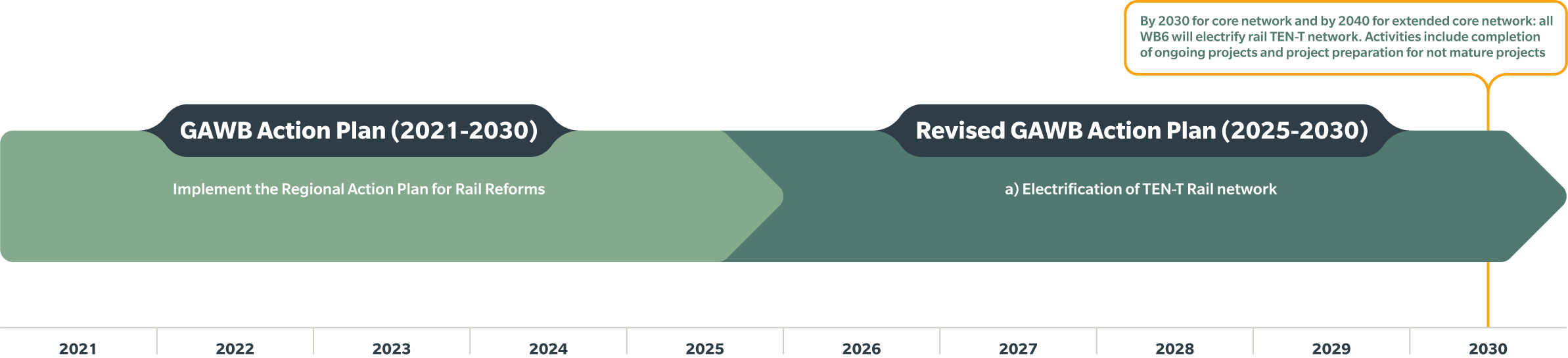
Revised Action 13(a) focuses on the electrification of the TEN-T rail network, supporting the decarbonisation of the transport sector and alignment with EU transport and climate objectives. It emphasises the development of rail infrastructure in line with EU standards and the promotion of sustainable and energy-efficient rail transport.
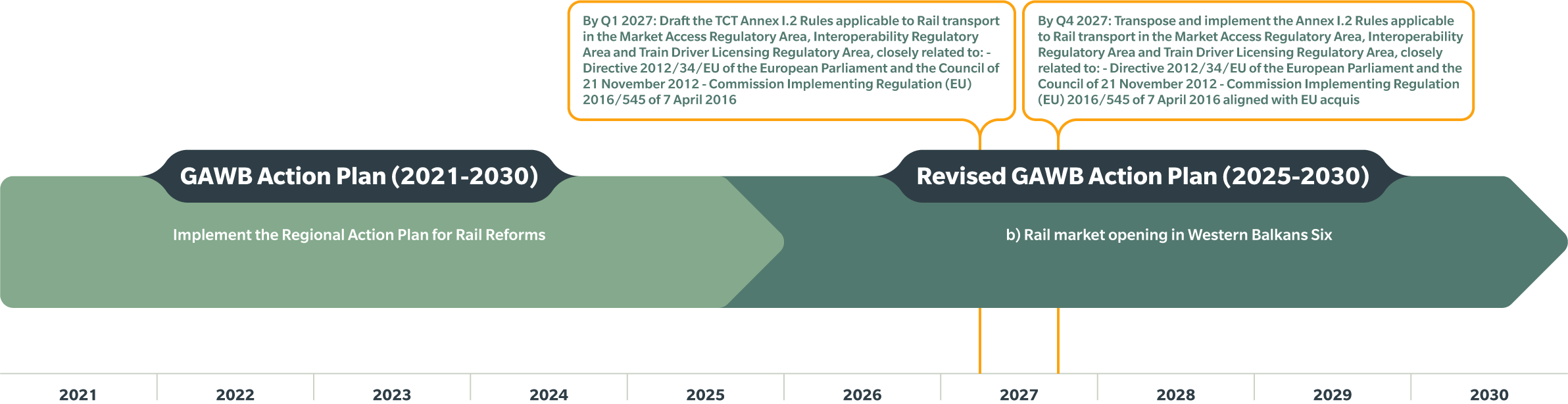
Revised Action 13(b) focuses on rail market opening in the WB6, supporting the integration of the regional rail market with the EU network. It emphasises regulatory alignment, increased competition, and improved interoperability to enhance the efficiency and attractiveness of rail services across the region.
Source: Transport Community (2025). Progress Report on Implementation of Next Generation Action Plans and EU Acquis Transposition for Western Balkans. Belgrade: Transport Community Secretariat. Data reproduced in: Regional Cooperation Council (RCC) (2025). Report on the Implementation of the Green Agenda for the Western Balkans Action Plan (GARI 2025). Sarajevo: RCC, Table 14.
Source: Transport Community (2025). Progress Report on Implementation of Next Generation Action Plans and EU Acquis Transposition for Western Balkans. Belgrade: Transport Community Secretariat. Data reproduced in: Regional Cooperation Council (RCC) (2025). Report on the Implementation of the Green Agenda for the Western Balkans Action Plan (GARI 2025), Figure 6. Sarajevo: RCC.
Source: Transport Community (2025). Progress Report on Implementation of Next Generation Action Plans and EU Acquis Transposition for Western Balkans. Belgrade: Transport Community Secretariat. Data reproduced in: Regional Cooperation Council (RCC) (2025). Report on the Implementation of the Green Agenda for the Western Balkans Action Plan (GARI 2025), Figure 7. Sarajevo: RCC.
Source: Transport Community (2025). Progress Report on Implementation of Next Generation Action Plans and EU Acquis Transposition for Western Balkans. Belgrade: Transport Community Secretariat. Data reproduced in: Regional Cooperation Council (RCC) (2025). Report on the Implementation of the Green Agenda for the Western Balkans Action Plan (GARI 2025), Figure 8. Sarajevo: RCC.
Source: Transport Community (2025). Progress Report on Implementation of Next Generation Action Plans and EU Acquis Transposition for Western Balkans. Belgrade: Transport Community Secretariat. Data reproduced in: Regional Cooperation Council (RCC) (2025). Report on the Implementation of the Green Agenda for the Western Balkans Action Plan (GARI 2025), Figure 9. Sarajevo: RCC.
Source: Regional Cooperation Council (RCC) (2024). Report on the Implementation of the Green Agenda for the Western Balkans Action Plan (GARI 2024), Annex. Sarajevo: RCC. Data as reported for 2024; the GARI 2025 carries no updated rail electrification figure.
Source: Transport Community (2025). Progress Report on Implementation of Next Generation Action Plans and EU Acquis Transposition for Western Balkans. Belgrade: Transport Community Secretariat. Data reproduced in: Regional Cooperation Council (RCC) (2025). Report on the Implementation of the Green Agenda for the Western Balkans Action Plan (GARI 2025). Sarajevo: RCC, the chart on the progress rate in transport facilitation (Section 2.3).
Source: Transport Community (2025). Progress Report on Implementation of Next Generation Action Plans and EU Acquis Transposition for Western Balkans, Figure 208. Belgrade: Transport Community Secretariat.