
Action 9
Prepare an assessment of socio-economic impact of decarbonisation at domestic and regional levels
ROADMAP PROGRESS
The 2025 GARI reports that, while formal government-endorsed socio-economic impact assessments of decarbonisation remain limited at domestic level, the regional analytical basis has deepened considerably. The two RCC and GIZ policy briefs, validated in 2024 and addressing the mitigation of adverse social and labour-market impacts and the needs of vulnerable groups, including coal workers and women, continue to inform regional policy dialogue. However, their recommendations have not yet been translated into domestic action plans with assigned institutional responsibilities and budgets.
The most significant new analytical contribution in 2025 is the OECD report Energy Prices and Subsidies in the Western Balkans: Reforms for a Fair and Green Future (May 2025). It estimates that, under current policies, WB6 could disburse approximately EUR 4.2 billion in financial support to the energy sector between 2025 and 2030. The World Bank's updated Climate and Development Report estimates that achieving economy-wide net zero would require approximately USD 32 billion in additional investment, equivalent to 2.1% of GDP annually through 2050, while projecting positive GDP outcomes under a net-zero scenario accompanied by appropriate structural reforms.
Commercial pressure is also increasing. The Energy Community's CBAM Readiness Tracker (October 2025) estimates potential annual CBAM-related financial exposure associated with WB6 exports of up to EUR 1.17 billion. No WB6 achieved the market coupling or equivalent carbon-pricing recognition required for CBAM exemption by the January 2026 deadline, exposing exporting firms to direct financial obligations at the EU border. Nevertheless, the core obligation, the preparation of formal, government-endorsed domestic socio-economic impact assessments, remains incomplete in most WB6. Albania, Bosnia and Herzegovina and Kosovo* have not produced dedicated assessments, while in Serbia and Montenegro relevant analysis is embedded in NECP and energy-strategy processes but has not been published as a standalone assessment. North Macedonia is comparatively more advanced, having adopted a Just Transition Roadmap and an Accelerated Coal Transition Investment Plan addressing the socio-economic implications of the coal phase-out.
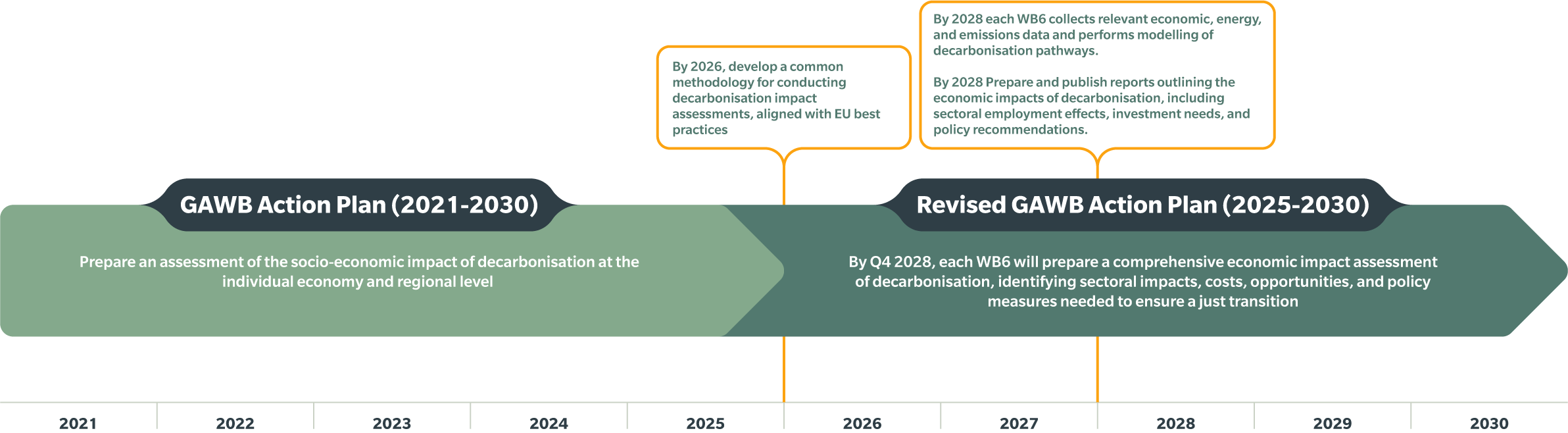
Note: Action 9 of the first Green Agenda Action Plan (2021–2030) is retained in the Revised Action Plan (2025–2030), with continued focus on assessing and addressing the social and economic impacts of the energy transition. The Revised Action Plan further emphasises structured just transition planning, labour market adaptation, and protection of vulnerable groups within the broader decarbonisation framework.
Comparisons of cumulative GDP impacts of different scenarios with baseline scenario
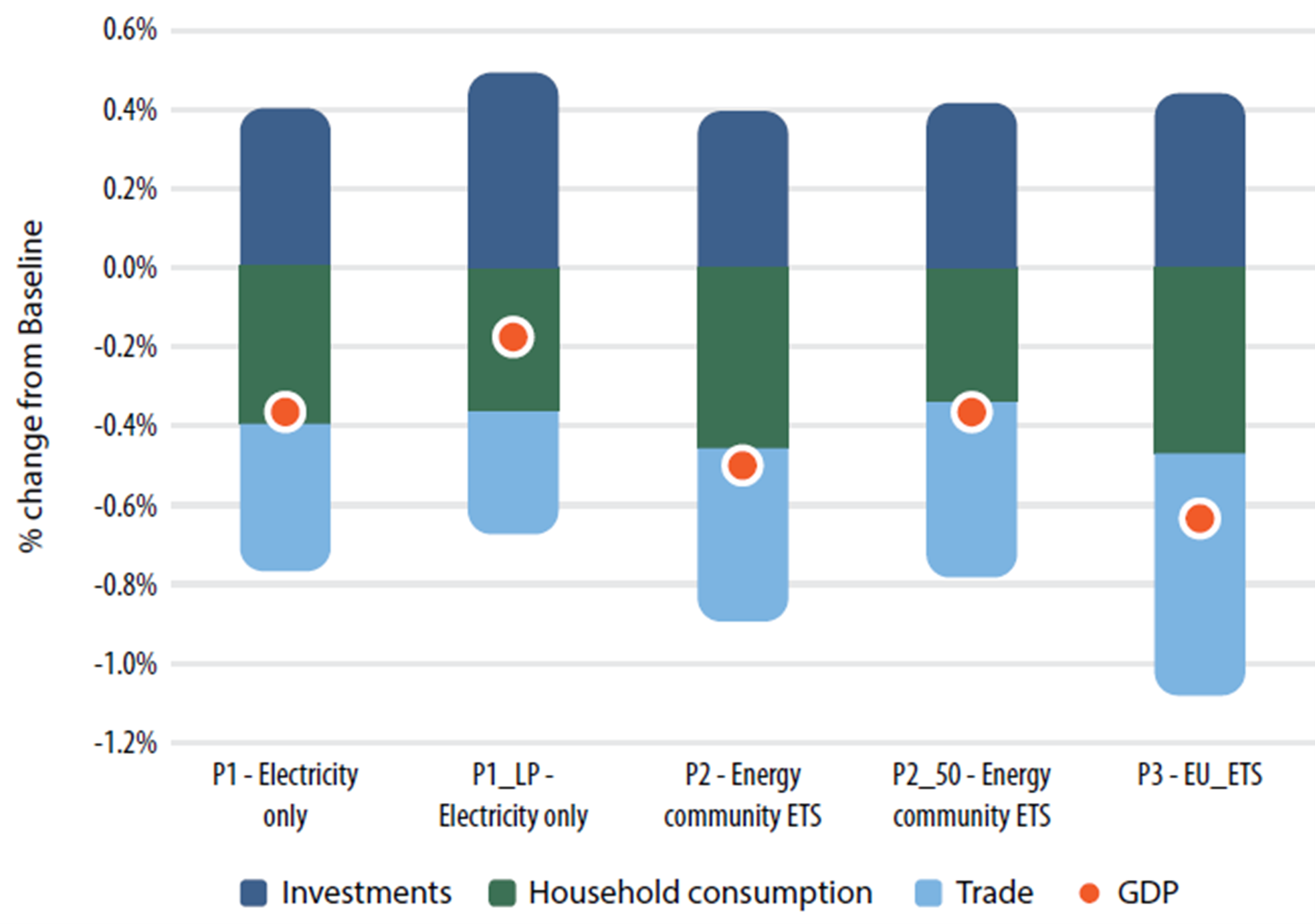
Source: Energy Community Secretariat (2024) Annual Implementation Report of the Acquis under the Treaty Establishing the Energy Community, November 2024. Data compiled in Regional Cooperation Council (RCC) (2024) Report on the Implementation of the Green Agenda for the Western Balkans Action Plan (2024 GARI), Figure 2.2.2.