

Action 16
Develop programmes for addressing energy poverty and financing schemes for household renovation and providing basic standards of living
ROADMAP PROGRESS
The 2025 GARI reports that progress in developing dedicated energy-poverty programmes and accessible household-renovation financing remained modest and uneven in 2025. The structural challenge is well documented: the share of people at risk of poverty across the region stood at 23.2% in 2024, and low-income households are disproportionately exposed to energy-price increases, while the financing instruments available to them remain inadequate. The OECD finds that support programmes in the most developed framework would need to be scaled by a factor of 2.5 for means-tested and 4.6 for vulnerable-customer schemes to compensate the most vulnerable.
Legislative and programmatic bases are strengthening in several WB6. Serbia remains the only WB6 with a statutory definition of energy poverty and operates a reformed subsidy scheme for energy-vulnerable consumers alongside the World Bank-supported SURCE programme, which links renovation support with vulnerable-household targeting. North Macedonia adopted a new Energy Law in May 2025, introducing targeted measures for energy-vulnerable consumers, although its support package does not yet comprehensively address poverty stemming from low incomes and poor building quality. Montenegro's EKO Fund delivered the region's most visible household energy-efficiency programme, but a dedicated mechanism linking renovation financing specifically to energy-poor households remains absent. Albania’s principal intervention was a reduction in household electricity tariffs, accompanied by emerging strategic commitments, but no dedicated renovation or heating-improvement programme targeted at energy-poor households was operational. Bosnia and Herzegovina made no progress on a domestic energy-poverty strategy or targeted household-renovation programme. Kosovo* lacks a formal legal definition, a reduction target, and standardised eligibility criteria, but has begun implementing targeted retrofit programmes for vulnerable households through KEEF, UNDP, EU, and government-supported initiatives.
The GARI identifies the adoption of statutory definitions of energy poverty across all WB6, together with means-tested renovation and social support schemes targeted at energy-poor households rather than capital-owning prosumers, as essential for effective programme design, monitoring and access to relevant pre-accession financing. Energy poverty mitigation is placed within the broader just transition agenda, requiring an integrated combination of targeted social protection, household energy efficiency investment and wider structural reform.
The residential sector accounts for approximately 30 to 60% of total final domestic energy consumption across the WB6. At current and even substantially accelerated renovation rates, the region would exceed a 50% share of renovated floor area only by around 2038, indicating that the renovation wave remains too slow to mitigate energy poverty within a relevant timeframe.
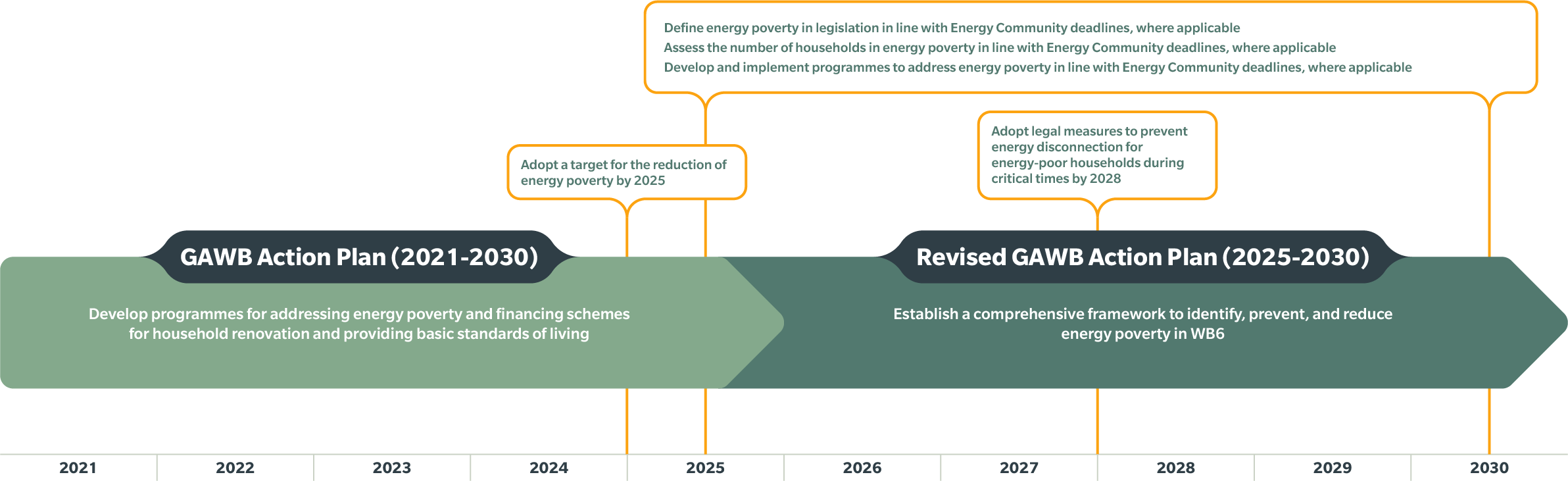
Note: Action 16 of the first Green Agenda Action Plan (2021–2030) is retained and strengthened in the Revised Action Plan (2025–2030) under Action 12. The revised action establishes a comprehensive framework for defining, assessing and reducing energy poverty, including legal definitions, measurable reduction targets, protection against disconnections during critical periods, and structured programmes aligned with Energy Community requirements.
Energy Poverty Eradication Policy Aspects
| Albania | Bosnia and Herzegovina | Kosovo* | Montenegro | North Macedonia | Serbia | |
|---|---|---|---|---|---|---|
| Definition of energy poverty | ○ | ● | ||||
| Definition of a vulnerable customer | ● | ○ | ● | ● | ● | ● |
| Protection against utility disconnections in case of non-payment | ● | ● |
Energy Community Secretariat’s policy recommendations
| Albania | Bosnia and Herzegovina | Kosovo* | Montenegro | North Macedonia | Serbia | |
|---|---|---|---|---|---|---|
| Develop a methodology to assess the number of households in energy poverty as required by the Governance Regulation. | ● | ● | ● | ● | ● | |
| Establish a domestic indicative objective to reduce energy poverty, including a timeframe. | ● | ● | ● | ● | ||
| Adopt a definition for energy poverty. | ● | ● | ● | ● | ||
| Include a detailed timeline, estimated budget, and financing sources for the policies and measures. | ● | ● | ● | |||
| Provide special support to energy-poor households in related policies and measures on energy efficiency and renewable energy sources to address the root causes of energy poverty. | ● | |||||
| Align the NECP targets and measures on energy poverty with the Energy Efficiency Action Plan (EEAP) and the Sustainable Energy Action Plan (SEAP), and vice versa. | ● | |||||
| Improve Eurostat data collection on relevant surveys (SILC and HBS). | ● | |||||
| Specify measures for the programme for vulnerable customers and their focus. | ● | |||||
| Specify the regulatory framework to address energy poverty, including a clear distribution of responsibilities for the policies and measures on energy poverty in NECPs. | ● | |||||
| Set up a dedicated funding, focusing on long-term energy poverty measures, including renovation, energy efficiency improvements, heating system improvements and installation for energy poor households. | ● | ● | ||||
| Establish a register for vulnerable customers. | ● | |||||
| Strengthen targeted support for energy-poor households within programmes and measures for energy efficiency and renewable energy. | ● | ● | ||||
| With regard to energy poverty, align NECPs with policies and measures mentioned in the Energy Strategy. | ● | |||||
| Strengthen long-term measures to address the root causes of energy poverty in the annual programme. | ● |