

Action 12
Support private and public buildings renovation schemes and secure appropriate financing
ROADMAP PROGRESS
The 2025 GARI records minimal and largely stable progress under this action, with implementation slowing across the region. Few WB6 show slight forward movement in strengthening renovation schemes and financing mechanisms, but most remain at the previous year's level. WB6 already at an advanced stage appear to be consolidating their position rather than expanding implementation. Overall, there is no evidence of broad regional acceleration in building-renovation support or the mobilisation of appropriate financing.
Although support programmes, loans and leasing instruments exist, private investment in building renovation remains limited. Structural factors such as the tax framework, weak protection of property rights and limited contract enforcement may be discouraging private investors. A central challenge is ensuring that available funds reach households that lack the financial capacity to invest independently, since many existing schemes primarily benefit financially capable households seeking additional leverage rather than those requiring basic support. Kosovo*'s Energy Efficiency Fund, which covers public buildings, residential renovation, and targeted support for socially vulnerable households, is highlighted as one of the region's more developed institutional delivery models for translating renovation financing into implementation.
In the next period, targeted schemes should balance investment in building-envelope upgrades with the replacement of inefficient heating systems, particularly given the widespread use of outdated solid-fuel stoves.
In the industrial and commercial sector, investment has focused more on on-site renewable energy solutions, such as small solar installations, wind turbines, biomass boilers and heat pumps, than on comprehensive energy efficiency improvements, while energy insecurity, regulatory instability, flooding risks and unclear property ownership continue to discourage long-term capital investment.
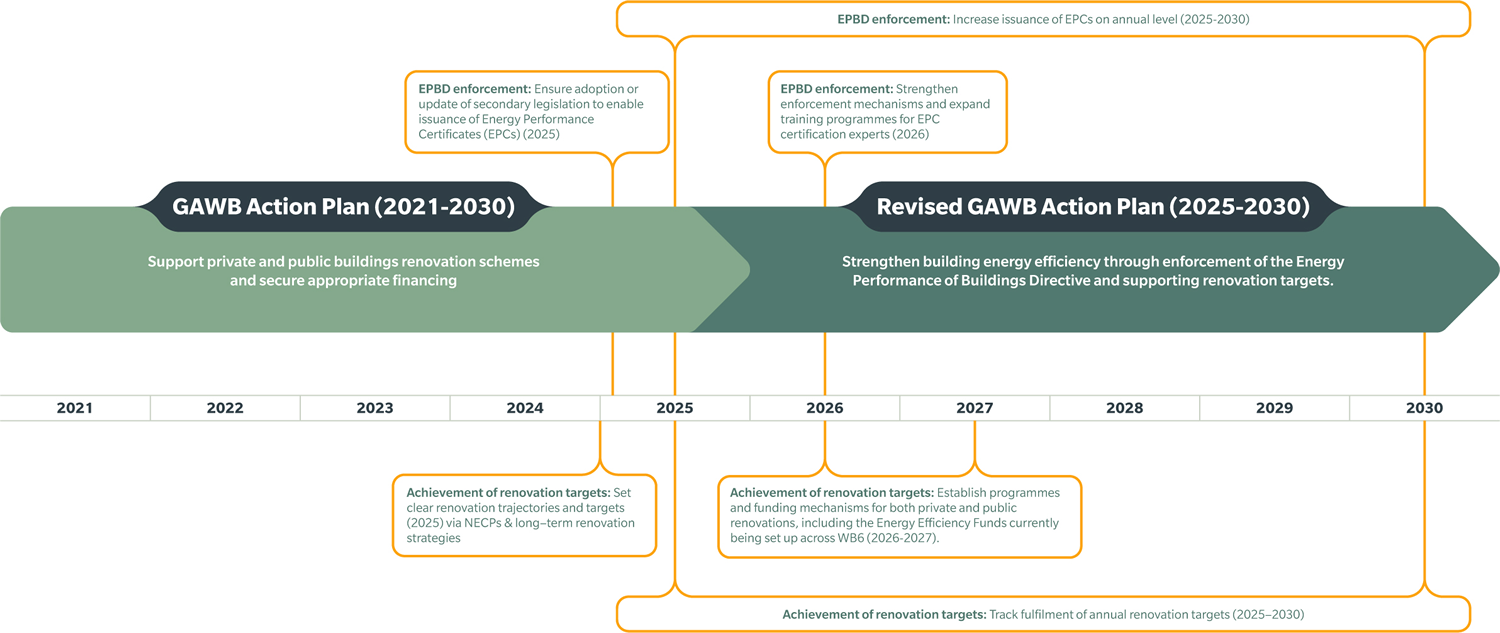
Note: Action 12 of the first Green Agenda Action Plan (2021–2030) is not retained as a standalone action in the Revised Action Plan (2025–2030). Its objectives are integrated under Action 7, which strengthens enforcement of the Energy Performance of Buildings framework and explicitly incorporates renovation trajectories, annual targets and establishment of financing mechanisms for both public and private buildings.
Source: Energy Community Secretariat (2025) Annual Implementation Report of the Acquis under the Treaty Establishing the Energy Community, November 2025. Data compiled in Regional Cooperation Council (RCC) (2025) Report on the Implementation of the Green Agenda for the Western Balkans Action Plan (GARI 2025), Table 8.