

Action 11
Transposition and full enforcement of the Energy Performance of Buildings Directive
ROADMAP PROGRESS
The 2025 GARI reports an overall positive trend in the transposition and enforcement of the Energy Performance of Buildings Directive (EPBD), although progress continues at different paces across the WB6. Several WB6 have made clear forward steps and are approaching full alignment and implementation, reflecting stronger legislative transposition and more effective enforcement mechanisms. Others show only marginal advancement or remain unchanged, indicating either consolidation at an already advanced stage or stalled reforms where further legal, administrative or enforcement measures remain necessary. Overall, implementation and enforcement continue to be uneven across the region.
Building performance is also influenced by renewable energy policies, including the promotion of self-consumption, energy communities and renewable energy in heating and cooling. Legal and regulatory frameworks for self-consumption and energy communities are relatively well developed across most of the region, although some gaps in regulatory clarity and practical implementation remain. Renewable heating and cooling presents a more uneven picture, with substantial progress in some WB6 but limited regulatory development, incentives or market uptake in others, making it a more significant area for further advancement.
Data for 2024 on policy measures with tangible long-term effects linking building-performance improvements with energy-poverty eradication are not yet available. This evidence gap limits the assessment of whether existing building and renewable-energy policies are delivering measurable and sustained benefits for energy-poor and vulnerable households. Further progress therefore requires not only completion of EPBD transposition, but also stronger enforcement capacity, practical implementation of building-performance requirements, and monitoring systems capable of demonstrating the effects of these measures on energy consumption and energy poverty.
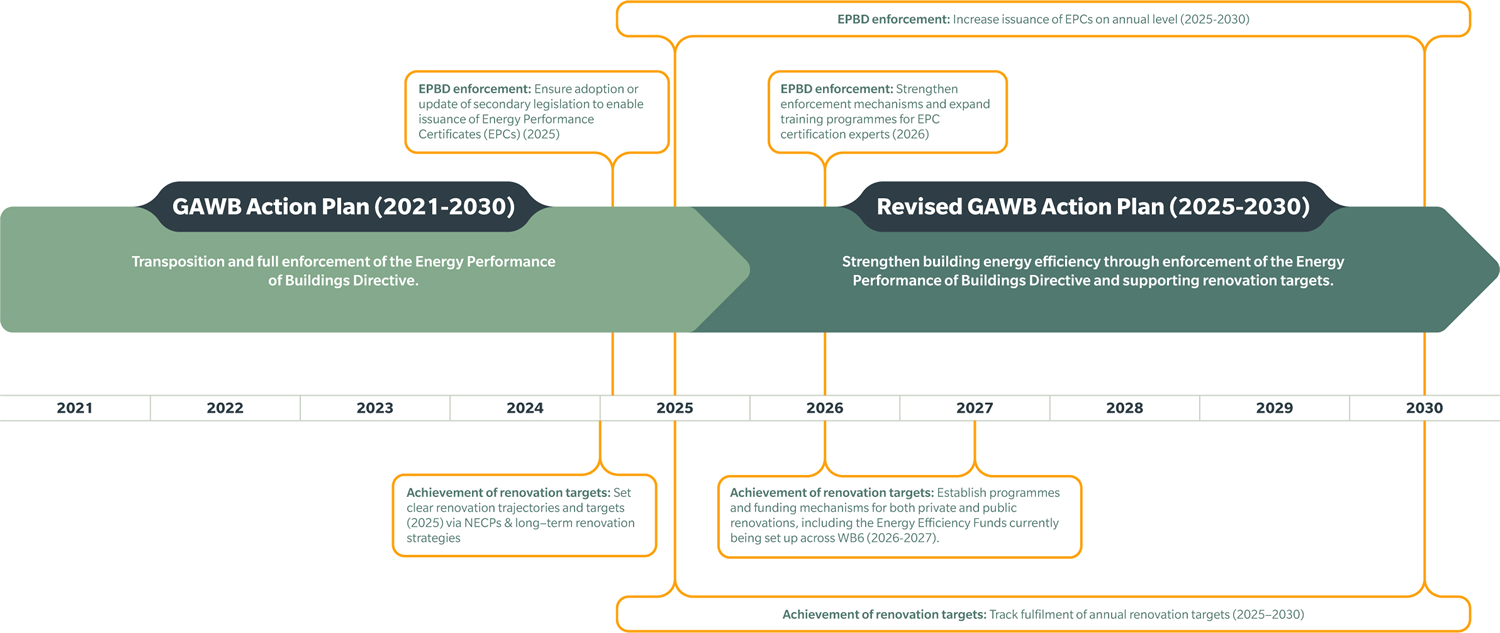
Note: Action 11 of the first Green Agenda Action Plan (2021–2030) is retained in the Revised Action Plan (2025–2030) as Action 7, with a strengthened focus on enforcement, monitoring, and the achievement of renovation targets. The revised action introduces more specific milestones related to secondary legislation, Energy Performance Certificate systems, renovation trajectories and financing mechanisms to support effective implementation.
Source: Energy Community Secretariat (2025) Annual Implementation Report of the Acquis under the Treaty Establishing the Energy Community, November 2025. Data compiled in Regional Cooperation Council (RCC) (2025) Report on the Implementation of the Green Agenda for the Western Balkans Action Plan (GARI 2025), Table 6.
POLICY MEASURES WITH TANGIBLE LONG-TERM EFFECTS THAT LINK BUILDING PERFORMANCE IMPROVEMENTS WITH ENERGY POVERTY ERADICATION
Updated data on policy measures linking building performance improvements with energy poverty eradication were not available for the 2025 GARI assessment.
The 2024 GARI matrix remains available in 2024 GARI, where its original source and reporting year (2024) are indicated.
Source: Energy Community Secretariat (2024) Annual Implementation Report of the Acquis under the Treaty Establishing the Energy Community, November 2024. Data compiled in Regional Cooperation Council (RCC) (2024) Report on the Implementation of the Green Agenda for the Western Balkans Action Plan (2024 GARI), Table 2.2.7.
Source: Energy Community Secretariat (2025) Annual Implementation Report of the Acquis under the Treaty Establishing the Energy Community, November 2025. Data compiled in Regional Cooperation Council (RCC) (2025) Report on the Implementation of the Green Agenda for the Western Balkans Action Plan (GARI 2025), Table 7.