

Carbon Border Adjustment Mechanism (CBAM)
The Carbon Border Adjustment Mechanism (CBAM)1 is the EU's instrument for applying a carbon price to certain carbon-intensive goods imported into the EU. Its primary objective is to prevent carbon leakage, a situation in which production relocates outside the EU to jurisdictions with less stringent climate policies, thereby undermining both global emission-reduction efforts and the competitiveness of EU industry.
CBAM seeks to ensure that imported goods and EU-produced goods face an equivalent effective carbon cost when placed on the EU market, while also encouraging cleaner industrial production in non-EU jurisdictions.
CBAM initially applies to a limited number of sectors with a high risk of carbon leakage, including cement, iron and steel, aluminium, fertilisers, electricity, and hydrogen.
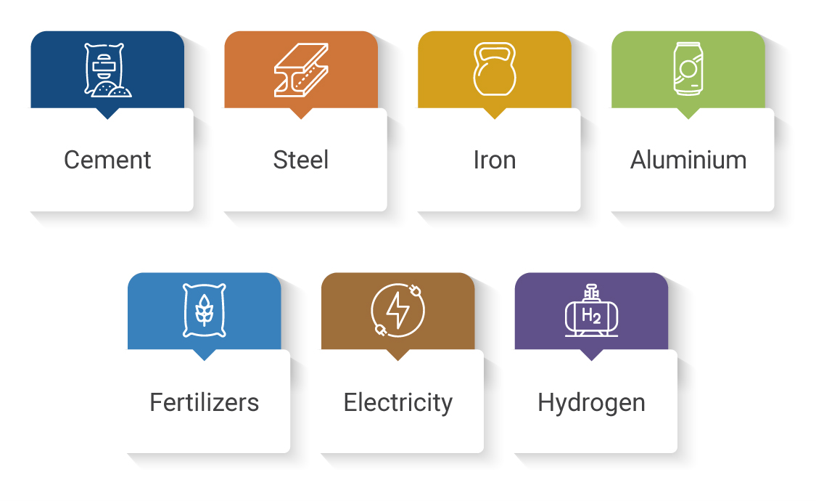
Illustration: Key sectors covered by CBAM
The CBAM is being implemented gradually. During the transitional phase (1 October 2023 – 31 December 2025), EU importers were required to report quarterly on:
- imported quantities;
- embedded greenhouse gas emissions; and
- any carbon price paid in the place of origin.
No financial obligations apply during this phase.
As of the definitive phase, which entered into force on 1 January 2026, EU importers (or their indirect customs representatives) importing CBAM-covered goods above the mass-based threshold of 50 tonnes per year are required to apply for authorised CBAM declarant status2.
CBAM certificates are purchased from the competent authority in the importer’s Member State of establishment. Their price is linked to the allowance price under the EU Emissions Trading System (EU ETS), calculated as a quarterly average in 2026 and as a weekly average from 2027 onwards, expressed in EUR per tonne of CO₂ emitted.