

EU Biodiversity Strategy for 2030
The EU Biodiversity Strategy for 20301 is a comprehensive and long-term policy framework aimed at halting biodiversity loss and restoring degraded ecosystems, placing nature on a path to recovery by 2050. It operationalises the EU’s global commitments under the Kunming–Montreal Global Biodiversity Framework2.
The Strategy is structured around four interlinked pillars:
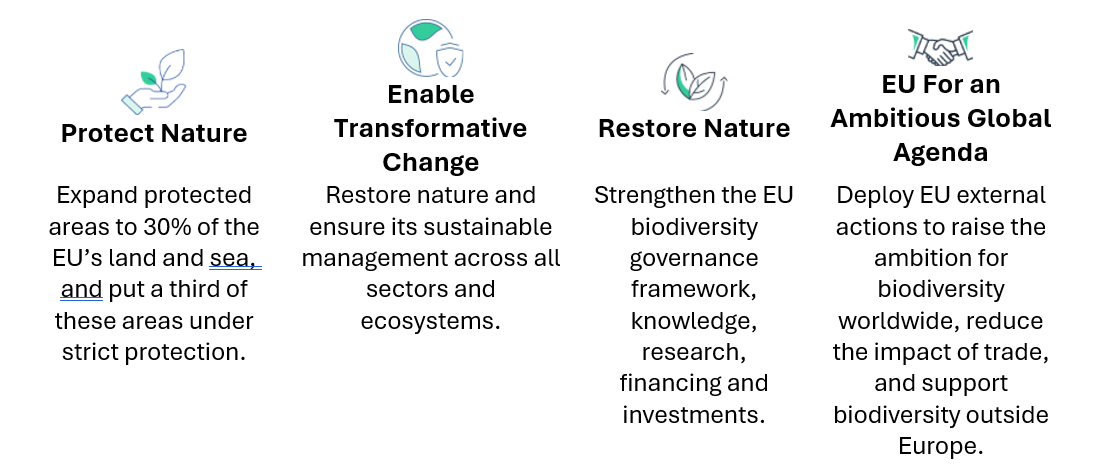
Together, these pillars shift EU action from fragmented conservation efforts towards a coherent, ecosystem-based approach, embedding biodiversity objectives into land-use planning, infrastructure development, agriculture, forestry, fisheries, and energy policy.
The Strategy commits the EU to protecting at least 30% of land and sea areas by 2030, with one third under strict protection, and to restoring degraded ecosystems through binding nature restoration targets. It also aims to mainstream biodiversity across key sectors such as agriculture, forestry, fisheries and finance, strengthen biodiversity governance and monitoring, and mobilise public and private financing to support implementation within the EU and globally.
The Strategy forms the basis of the EU’s position in international biodiversity negotiations and its engagement under the Convention on Biological Diversity. Its delivery is anchored in binding EU legislation and policy instruments, including:
- the Birds and Habitats Directives, which underpin the Natura 2000 network;
- the proposed Nature Restoration Regulation, establishing legally binding restoration targets;
- the EU Forest Strategy for 2030; and
- complementary measures under the Zero Pollution Action Plan.
Together, these instruments translate strategic biodiversity objectives into enforceable requirements, ensuring consistent implementation, monitoring, and reporting across Member States and sectors.
2 Convention on Biological Diversity. n.d. Kunming–Montreal Global Biodiversity Framework. Accessed March 2026. https://www.cbd.int/gbf/introduction