

Energy Performance of Buildings Directive (EPBD)
The Energy Performance of Buildings Directive (EPBD)1 is the EU’s instrument for reducing energy consumption and greenhouse gas emissions from buildings and for achieving the full decarbonisation of the EU building stock by 2050.
Buildings account for approximately 40% of final energy consumption and over one-third of energy-related emissions in the EU, making them a critical sector for meeting EU climate and energy objectives. The EPBD establishes a common framework for improving the energy performance of buildings across the EU, covering new construction, existing buildings, renovations, and technical building systems.
The revised EPBD entered into force on 28 May 2024 and must be transposed into domestic law by 29 May 2026. It places a strong emphasis on accelerating renovation rates, particularly for the worst-performing buildings, while allowing flexibility to reflect domestic circumstances.
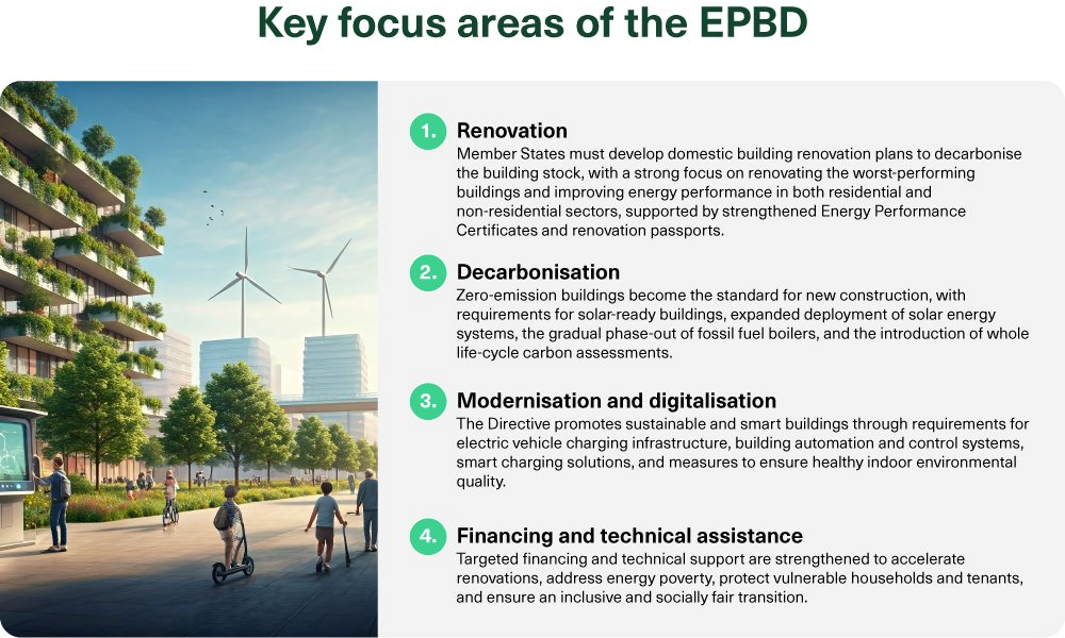
Illustration: Key focus areas of revised EPBD ©SP
Electricity Market Design
The Electricity Market Design2 reform is the European Union’s structural response to the 2022 energy crisis, which exposed vulnerabilities in the existing market design. Under the merit order principle, electricity prices are set by the marginal cost of the most expensive generation source, often fossil fuels, so sharp increases in fossil fuel prices can translate directly into higher electricity prices for consumers. While emergency measures were introduced in 2022 to shield consumers, the reform focuses on long-term solutions to prevent similar price shocks in the future.
Objectives:
Source: https://www.consilium.europa.eu/en/policies/electricity-market-reform/
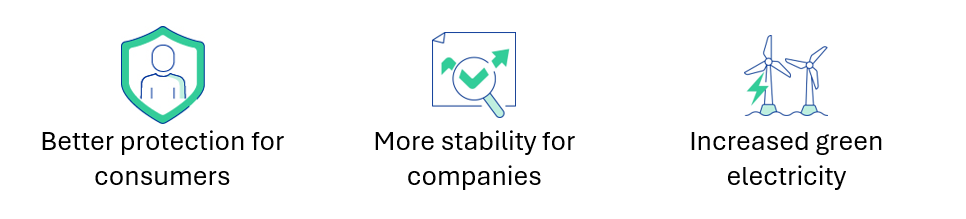
The reform strengthens consumer protection and choice by expanding access to fixed and dynamic electricity contracts, improving transparency, and reinforcing safeguards for vulnerable consumers, while facilitating access to renewable energy through local electricity trading.
For businesses and producers, it enhances price stability and investment certainty by promoting long-term contracts and supporting new low-carbon generation through two-way contracts for difference, protecting both consumers and public budgets from excessive price volatility.
At the system level, the reform improves the integration of renewable energy by strengthening system operator obligations, improving market monitoring, and increasing generation predictability, supporting stable prices and the EU’s climate objectives under Fit for 55.
The EU Electricity Market Design reform is implemented through amendments to the Electricity Market Regulation3, which establishes binding rules for the functioning of wholesale markets, consumer protection, and the organisation of retail markets across the EU.
1 European Union. 2024. Directive (EU) 2024/1275 on the energy performance of buildings (recast). OJ L, 8 May 2024. Accessed March 2026.
https://eur-lex.europa.eu/eli/dir/2024/1275/oj/eng
2 European Union. 2023. Directive (EU) 2023/1791 on energy efficiency and amending Regulation (EU) 2023/955. OJ L 231, 20 September 2023. Accessed March 2026.
https://eur-lex.europa.eu/legal-content/EN/TXT/?uri=OJ:L_202401711
3 European Union. 2023. Directive (EU) 2023/1791 on energy efficiency and amending Regulation (EU) 2023/955. OJ L 231, 20 September 2023. Accessed March 2026.
https://eur-lex.europa.eu/legal-content/EN/TXT/?uri=OJ:L_202401711;
European Union. 2024. Directive (EU) 2024/1275 on the energy performance of buildings (recast). OJ L, 8 May 2024. Accessed March 2026.
https://eur-lex.europa.eu/legal-content/EN/TXT/?uri=OJ:L_202401747